Kiribati leads education spending as percentage of GDP

A Our World in Data study ranks Kiribati first in education investment at 16.4% of GDP. Colombia places third in South America with 5.3%.

The Republic of Kiribati, with just over 110,000 inhabitants, tops the list with an investment of 16.4% of its gross domestic product in education. It is followed by Tuvalu at 12.8% and Micronesia at 11.6%.

The study draws on UNESCO, OECD and national records to measure total public education spending, including teacher salaries, infrastructure and transfers.

In South America, Bolivia records the highest share at 7.5%, followed by Brazil at 5.6%. Colombia ranks third at 5.3%.

Countries with the lowest investment include Somalia at less than 0.1%, Nigeria at 0.3% and Zimbabwe at 0.4%. The analysis covers data through 2026.
Articoli correlati

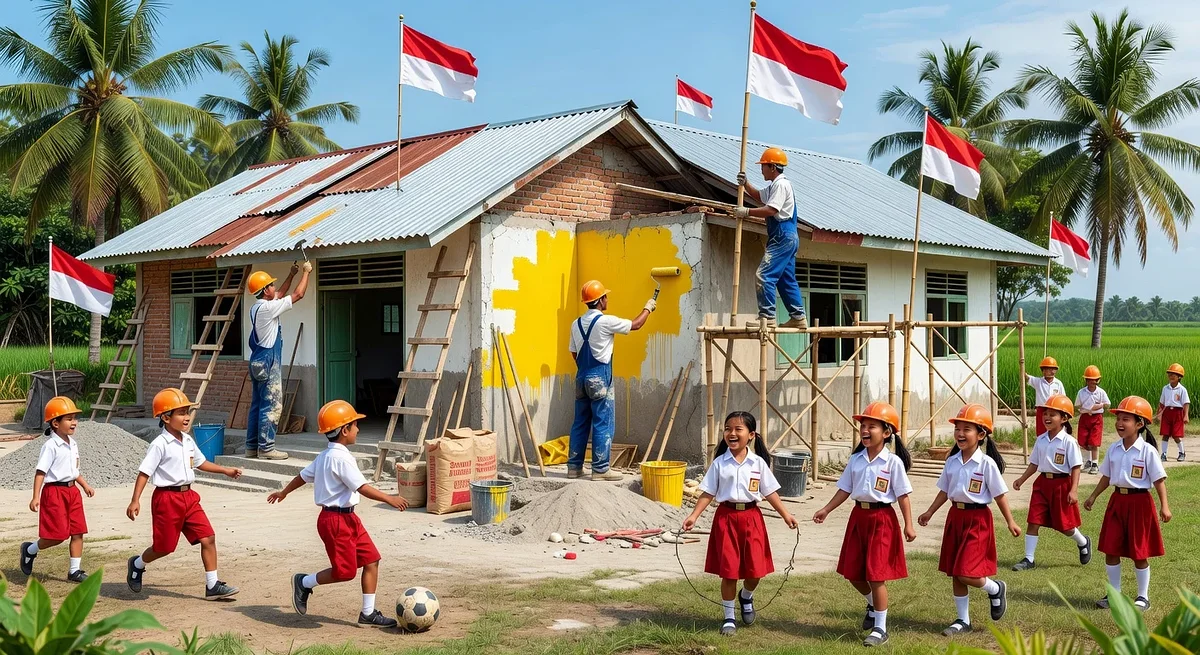
Illustration of workers renovating a rural Indonesian school with children playing nearby, representing the government's revitalization program.
Immagine generata dall'IA

Government sets 2026 target to revitalize 71,744 schools under five-year plan

Riportato dall'IA Immagine generata dall'IA

The Indonesian government targets revitalization of 71,744 educational units in 2026 with a Rp14 trillion budget as part of President Prabowo Subianto's broader five-year plan to renovate 300,000 schools. Education Minister Abdul Mu'ti stated that Rp2.6 trillion has been realized so far. The program prioritizes schools damaged by disasters and those in underdeveloped regions.

Yahia Aboul Fotouh, amministratore delegato dell'Housing and Development Bank, ha sottolineato gli investimenti dell'Egitto nell'istruzione durante il quinto vertice annuale sugli investimenti nell'istruzione.

Riportato dall'IA

The Alliance of Concerned Teachers called for an increase in the national education budget to at least six percent of GDP to reduce the financial burden on educators and parents.

César Ferrari, Colombia's financial superintendent, spoke at the LR Economía verde más sostenible más rentable forum to highlight the need to change the country's economic growth model.

Riportato dall'IA

Abelardo de la Espriella, Colombia's president-elect, held meetings with the World Bank and IMF to advance projects in infrastructure, health and education. Fitch Ratings warned of a fiscal deficit close to 7% of GDP and other economic challenges facing the new administration.

Colombia's Finance Ministry reported that national government gross debt reached 65.1% of GDP in the first quarter of 2026, the highest level for that period since 1999. Net debt rose to 59% of GDP.

Riportato dall'IA

The Autonomous Fiscal Rule Committee reported that central government total and primary spending through April 2026 reached 7.5% and 6% of GDP respectively.


Questo sito web utilizza i cookie

Utilizziamo i cookie per l'analisi per migliorare il nostro sito. Leggi la nostra politica sulla privacy per ulteriori informazioni.
Rifiuta