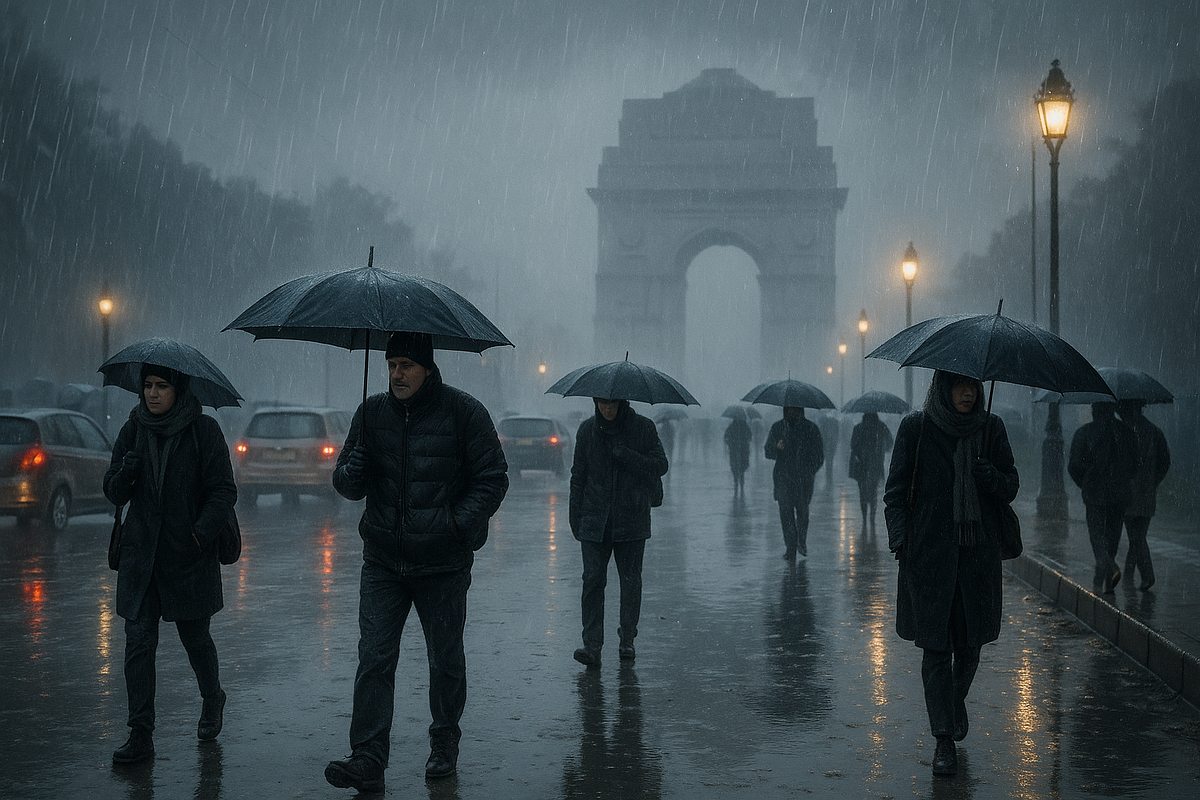
Rainfall on Tuesday made January the wettest in Delhi in four years, with a total of 25 mm recorded. However, it failed to improve air quality, pushing the AQI to 336. The IMD forecasts temperature fluctuations and light rain on February 1.
New Delhi, January 28, 2026: Delhi and the NCR experienced widespread showers on Tuesday, January 27, causing the maximum temperature to drop to 16.9 degrees Celsius, five degrees below normal. This marked a 6.3-degree fall from Monday's 23.2 degrees. The minimum temperature was 8 degrees Celsius, slightly up due to overcast skies. Safdarjung recorded 4.2 mm of rain that day, while Palam saw 14.6 mm and Ridge 14.4 mm. January's total rainfall reached 25.3 mm, the highest in four years since 88.2 mm in 2022. Rainfall on January 23 was 19.8 mm.
According to the IMD, Wednesday will see generally cloudy skies without rain. The minimum temperature will hover between 11-13 degrees, but could dip to 7 degrees on Thursday and Friday, and 5 degrees on Saturday. The maximum is expected to rise to 21 degrees by the weekend. A yellow alert for light rain is issued for February 1. No 'cold day' was declared as criteria were not met over two days.
Despite the rain, Delhi's 24-hour average AQI worsened from 241 ('poor') on Monday to 336 ('very poor') on Tuesday, reaching 346 by evening. Noida's AQI rose from 219 to 331, and Gurugram's from 276 to 306. Wazirpur recorded 421. Experts note the low-intensity rain was insufficient to clear PM2.5 particles. The EWS predicts 'poor' AQI on January 28-29, deteriorating to 'very poor' on January 30.