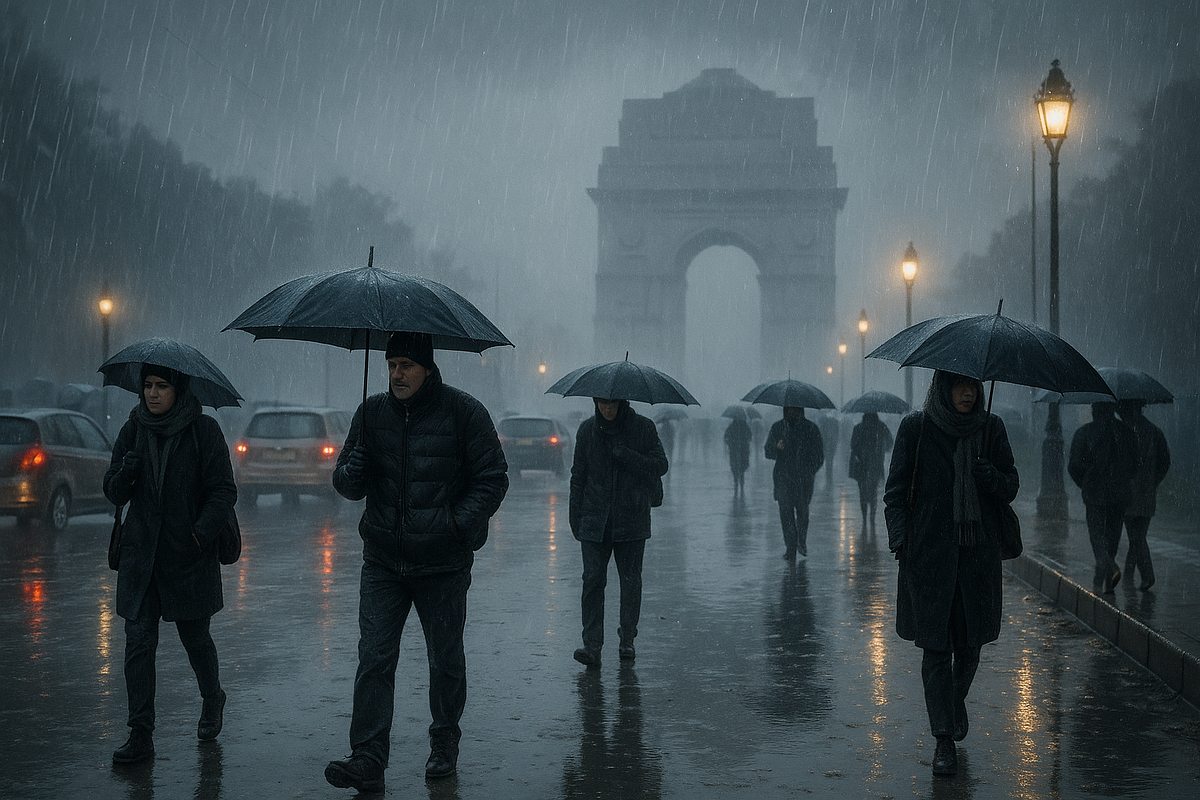
Rain-drenched Delhi street with smoggy haze and bundled pedestrians, depicting the city's wettest January amid poor air quality.
AIによって生成された画像

Delhi sees wettest January in four years with increased chill

AIによって生成された画像

Rainfall on Tuesday made January the wettest in Delhi in four years, with a total of 25 mm recorded. However, it failed to improve air quality, pushing the AQI to 336. The IMD forecasts temperature fluctuations and light rain on February 1.

New Delhi, January 28, 2026: Delhi and the NCR experienced widespread showers on Tuesday, January 27, causing the maximum temperature to drop to 16.9 degrees Celsius, five degrees below normal. This marked a 6.3-degree fall from Monday's 23.2 degrees. The minimum temperature was 8 degrees Celsius, slightly up due to overcast skies. Safdarjung recorded 4.2 mm of rain that day, while Palam saw 14.6 mm and Ridge 14.4 mm. January's total rainfall reached 25.3 mm, the highest in four years since 88.2 mm in 2022. Rainfall on January 23 was 19.8 mm.

According to the IMD, Wednesday will see generally cloudy skies without rain. The minimum temperature will hover between 11-13 degrees, but could dip to 7 degrees on Thursday and Friday, and 5 degrees on Saturday. The maximum is expected to rise to 21 degrees by the weekend. A yellow alert for light rain is issued for February 1. No 'cold day' was declared as criteria were not met over two days.

Despite the rain, Delhi's 24-hour average AQI worsened from 241 ('poor') on Monday to 336 ('very poor') on Tuesday, reaching 346 by evening. Noida's AQI rose from 219 to 331, and Gurugram's from 276 to 306. Wazirpur recorded 421. Experts note the low-intensity rain was insufficient to clear PM2.5 particles. The EWS predicts 'poor' AQI on January 28-29, deteriorating to 'very poor' on January 30.

人々が言っていること

Discussions on X focus on Delhi recording its wettest January in four years with 25mm rainfall, leading to cooler temperatures but failing to improve air quality, with AQI hitting 336. Users express frustration over persistent pollution despite rain, while news accounts and individuals share IMD forecasts for ongoing clouds and light rain. Sentiments are mostly negative regarding AQI and neutral on weather updates.

関連記事

Delhi-NCR skyline obscured by severe smog and fog, AQI 391, highlighting air pollution crisis amid cold wave.
AIによって生成された画像

Delhi-NCR faces severe pollution and fog with AQI at 391

AIによるレポート AIによって生成された画像

On December 28, 2025, Delhi-NCR grappled with very poor air quality, recording an average AQI of 391. Dense fog and a cold wave prompted alerts for travelers, with pollution levels alarmingly high in surrounding areas too.

On the morning of February 1, 2026, parts of Delhi and the National Capital Region (NCR) experienced light rain, while the Air Quality Index remained in the very poor category. The India Meteorological Department (IMD) issued a yellow alert for thunderstorms and fog. Maximum temperatures are expected near 18 degrees Celsius, with minimums around 11 degrees Celsius.

AIによるレポート

Delhi recorded the season's lowest minimum temperature of 4.6°C on Friday, accompanied by surprise rain in the national capital and nearby areas like Noida and Gurugram. Dense fog persisted, intensifying the chill.

Delhi remains under a cold wave with dense fog and 'poor' air quality for a second day on January 5, prompting airline warnings for flight delays. The IMD forecasts a 2-3°C drop in minimum temperatures across northwest India over the next four days.

AIによるレポート

On January 14, 2026, Delhi was enveloped in dense fog, a cold wave, and toxic air, disrupting daily life. According to the Central Pollution Control Board, the city's overall Air Quality Index stood at 357 at 7 a.m., falling in the 'very poor' category. This has severely impacted public health and transportation.

An intense cold wave has gripped north India, with Gurugram recording a low of 0.6°C, colder than Shimla. Delhi shivered at a minimum of 3°C. The India Meteorological Department has issued an orange alert for Haryana and Delhi.

AIによるレポート

Delhi's air quality has improved sharply, with the average AQI reaching 271 in the poor category, down from severe levels in previous days. The Commission for Air Quality Management has revoked stage IV of the Graded Response Action Plan, though stage III remains in effect. However, forecasts indicate the situation may worsen again in the coming days.


このウェブサイトはCookieを使用します

サイトを改善するための分析にCookieを使用します。詳細については、プライバシーポリシーをお読みください。
拒否