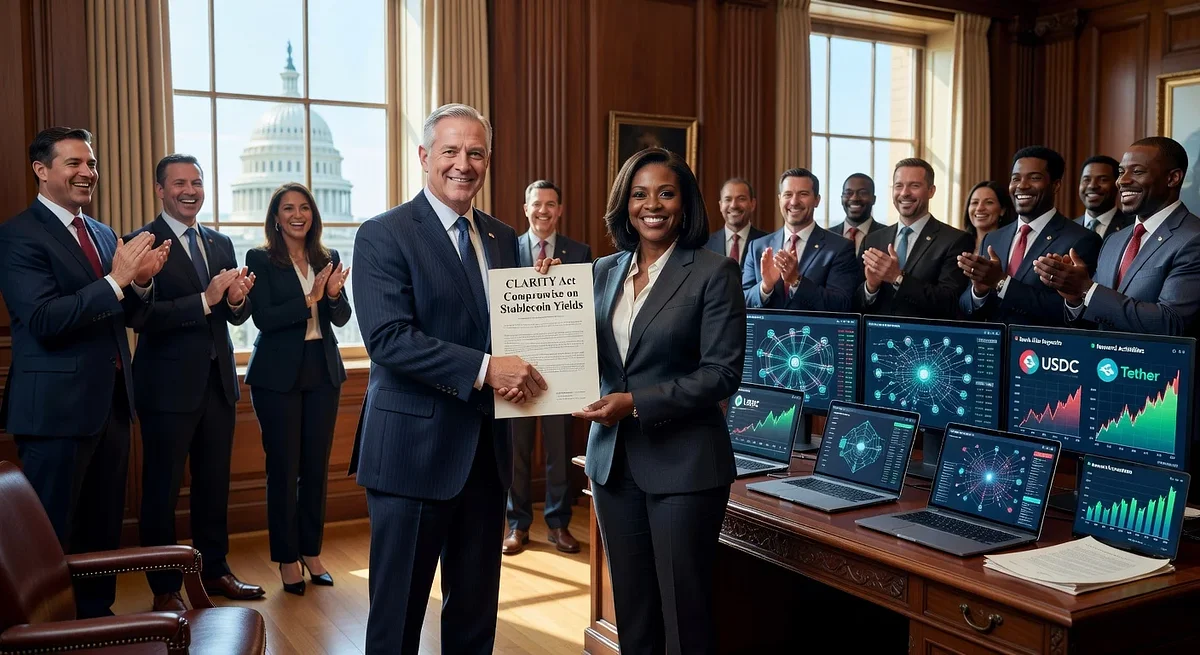
Lawmakers are working on a compromise over stablecoin rewards to revive the Digital Asset Market Clarity Act, stalled by banking disputes and President Trump's legislative priorities. On March 8, 2026, Trump elevated the unrelated SAVE America Act, freezing Senate time for other bills. The crypto industry, meanwhile, highlighted AI agents' reliance on existing infrastructure without new laws.
The Digital Asset Market Clarity Act, which passed the House in July 2025 by a 294-134 vote, aims to create a federal framework for digital assets by dividing regulatory oversight between the SEC and CFTC. It has faced delays, including a postponed Senate Banking Committee markup on January 14, 2026, after Coinbase CEO Brian Armstrong withdrew support. Armstrong cited concerns over restrictions on tokenized equities, DeFi provisions allowing broad government access to user data, erosion of CFTC authority, and elimination of stablecoin rewards, which accounted for nearly 20% of Coinbase's third-quarter 2025 revenue.
On March 8, 2026, President Trump posted on Truth Social that he would not sign any legislation until the SAVE America Act—a voting reform bill requiring proof of citizenship and photo ID for federal registration, passed by the House 218-213—cleared Congress in its strongest form. "It supersedes everything else," he wrote. "MUST GO TO THE FRONT OF THE LINE." This priority, unrelated to crypto, has jammed the Senate calendar, with prediction markets estimating an 18% chance of CLARITY Act passage in 2026.
At an American Bankers Association summit in Washington on March 10, 2026, senators discussed a stablecoin compromise to address bankers' fears of deposit flight. Senator Angela Alsobrooks (D-MD), working with Senator Thom Tillis (R-NC), said the deal would leave both sides "just a little bit unhappy." She added, "The compromise... will allow us to have the guardrails in place... to prevent... the deposit flight... and to allow the innovation to grow at the same time." Senator Mike Rounds (R-SD) suggested tying rewards to account activity rather than holdings. ABA President Rob Nichols noted the GENIUS Act barred stablecoin issuers from paying interest, warning that unbound crypto exchanges could evade intent. JPMorgan CEO Jamie Dimon indicated acceptance of transaction-based rewards.
The morning after Trump's post, on March 9, Armstrong posted on X that AI agents—autonomous software for tasks like trading—would soon outnumber human transactions, incompatible with traditional finance's identity requirements. He highlighted Coinbase's February 2026 Agentic Wallets on the x402 protocol, which had processed over 50 million transactions. Binance founder Changpeng Zhao echoed this, predicting AI agents would make a million times more payments using crypto, via BNB Chain's February 2026 infrastructure.
That day, Nvidia disclosed NemoClaw, an open-source platform for enterprise AI agents, targeting partnerships with Salesforce, Cisco, Google, Adobe, and CrowdStrike. While not crypto-specific, it underscores demand for autonomous transaction infrastructure that crypto provides.
Other hurdles include DeFi vulnerabilities, CFTC/SEC appointments, and a proposed ban on officials profiting from crypto ties, aimed at Trump. Senate floor time remains tight amid issues like the war in Iran.