Proshare identifies major risks to Nigeria's 2026 economy

Experts from the financial intelligence platform Proshare have outlined five primary risks that could hinder Nigeria's economic outlook for 2026. Among these risks are geopolitical tensions and reform fatigue. The report highlights challenges in achieving projected economic goals.

A report by Proshare, a financial and economic intelligence platform, has pinpointed five key risks threatening Nigeria's economic prospects in 2026. The analysis emphasizes geopolitical tensions and reform fatigue as major concerns. These factors, according to the experts, could impede progress toward the anticipated economic outlook.

The publication, dated March 4, 2026, provides insights from specialists monitoring Nigeria's fiscal landscape. While the full list of five risks is not detailed in available excerpts, the title underscores the prominence of external geopolitical pressures and internal challenges related to sustaining reforms. Proshare's assessment aims to guide stakeholders in navigating potential obstacles to growth.

This report comes at a time when Nigeria faces ongoing economic adjustments, though specific timelines or additional quotes from the experts are not elaborated in the summary provided.
Labaran da ke da alaƙa

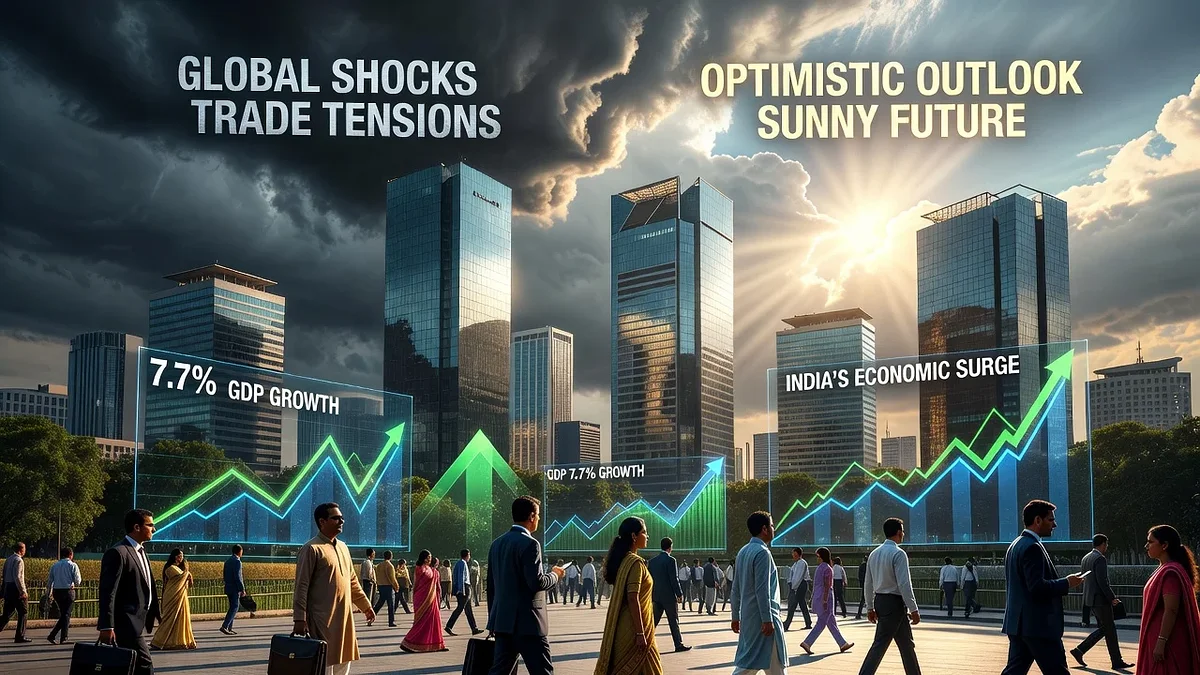
Illustration of India's Economic Survey 2025-26 tabling in Parliament, highlighting GDP growth, reforms, manufacturing revival, and PM Modi's approval.
Hoton da AI ya samar

India's economic survey 2025-26 highlights growth and reforms

An Ruwaito ta hanyar AI Hoton da AI ya samar

India's Economic Survey 2025-26, tabled in Parliament on January 30, 2026, projects robust GDP growth amid global uncertainties and recommends key reforms for strategic resilience. It emphasizes manufacturing revival, digital curbs and policy overhauls to bolster economic stability. Prime Minister Narendra Modi praised it as a roadmap for inclusive development.

Building on the roller-coaster business year of 2025—which saw Eskom gains, budget battles, and eventual credit upgrades—South Africa begins 2026 with enhanced macroeconomic stability, including reliable power supply and a credit rating upgrade, fostering a more predictable business environment. However, persistent issues like high unemployment, crime, and slow coalition politics limit broader recovery. This balance creates a narrow window for progress rather than a complete turnaround.

An Ruwaito ta hanyar AI

Finance Minister Enoch Godongwana is set to deliver South Africa's 2026 Budget speech on February 25, amid positive economic signals including a credit rating upgrade and rising commodity prices. These factors are expected to support efforts to cap the country's debt at 77.9% of GDP and advance fiscal consolidation. Economists anticipate a focus on stabilizing debt and outlining a path to lower ratios in the medium and long term.

India's economy could face challenges from the West Asia conflict, which may impact oil prices and overall growth. According to Crisil Intelligence, real GDP growth is expected to reach 7.1 percent in FY27, driven by consumer spending and investment. Exports are anticipated to increase, while retail inflation might climb to 4.3 percent.

An Ruwaito ta hanyar AI

Following late-2025 reports of economic promise and investor optimism based on preliminary data, South Africa's gross domestic product expanded by just 1.1% for the full year of 2025—up from 0.5% in 2024 but below the Treasury's 1.4% estimate. Quarterly growth hit 0.4% in Q4 after a revised 0.3% in Q3. Industrial sectors like mining and manufacturing contracted, offset by gains in finance and investment.

The African Mining Indaba 2026 began in Cape Town on 9 February, highlighting challenges in South Africa's mining industry amid US tariffs and logistics issues. The Minerals Council South Africa launched its 2025 Facts and Figures report, revealing profit gains but persistent hurdles in electricity, rail, and exploration. Industry leaders expressed cautious optimism for stabilisation in 2026.

An Ruwaito ta hanyar AI

The Bank of France has cut its GDP growth forecasts to 0.9% for 2026 and 0.8% for 2027 due to surging energy prices from the Middle East conflict. This adjustment is based on a main scenario of temporary hydrocarbon price increases. The bank also expects inflation at 1.7% this year.


Wannan shafin yana amfani da cookies

Muna amfani da cookies don nazari don inganta shafin mu. Karanta manufar sirri mu don ƙarin bayani.
Ƙi