Public discussions help identify national challenges

Public discussions held across Ethiopia urge the government to identify and solve current and national issues, experts say. These forums create opportunities to address good governance problems and build trust between the public and authorities.

In Addis Ababa on Tahsas 7, 2018, Dr. Bimerk Birhanu, a political science lecturer at Mizan Tepi University, told Fana Media Corporation that public discussions involving various community groups are underway. He emphasized that these discussions hold great significance in engaging the public to overcome Ethiopia's internal and external challenges that it faces.

Similarly, Yitagesu Belete, a lecturer in the university's good governance department, stated that discussions conducted in various parts of the country have enabled the government to tackle current problems. Experts suggest that responding to public-raised issues through diverse platforms before holding discussions makes the government more accountable.

Furthermore, providing solutions to identified matters plays a crucial role in fostering trust between the public and the government while strengthening national unity. The experts agreed that the government's discussions with various community sections over the past month have significantly contributed to identifying problems at their roots and offering solutions.
関連記事

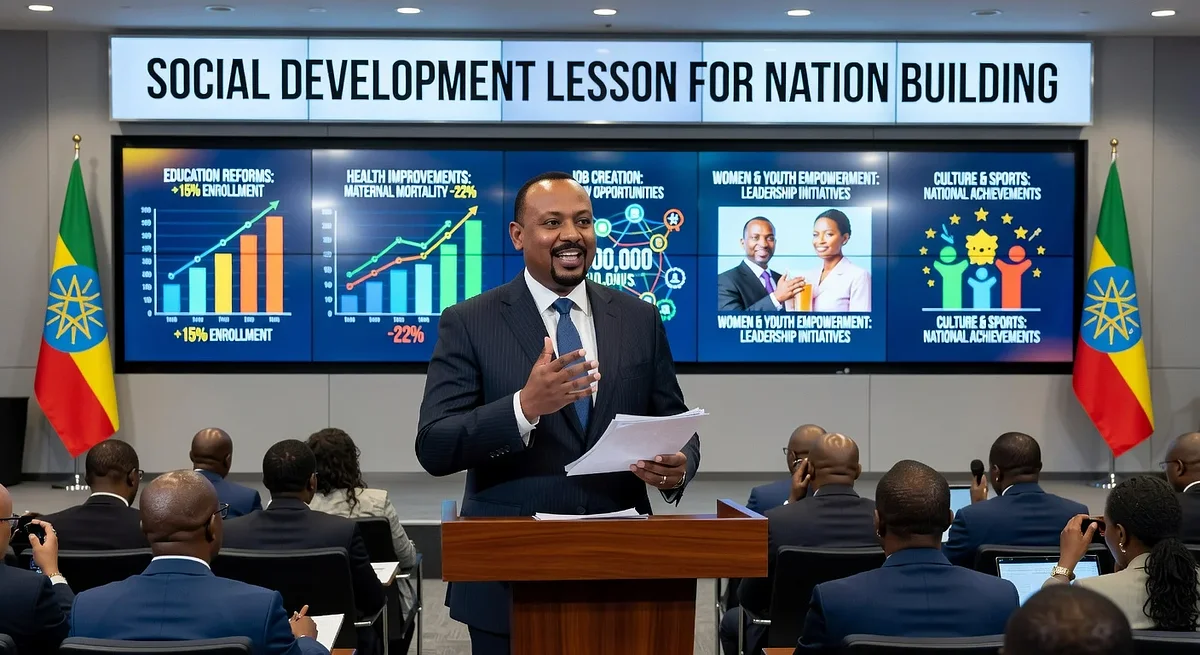
Prime Minister Abiy Ahmed highlights Ethiopia's social sector achievements at Addis Ababa briefing.
AIによって生成された画像

Prime Minister Abiy Ahmed highlights Ethiopia's social sector achievements at Addis Ababa briefing

AIによるレポート AIによって生成された画像

Prime Minister Dr. Abiy Ahmed presented major outcomes in Ethiopia's social and economic sectors at a briefing in Addis Ababa on April 28, 2026 (Miyazya 20, 2018 E.C.), themed 'Social development lesson for nation building.' The event reviewed comprehensive reforms and achievements in education, health, job creation, women's and youth empowerment, culture, sports, and more, emphasizing their role in national growth.

Mesfin Araya, chief commissioner of Ethiopia's National Dialogue Commission, stated that no questions or problems are unsolvable through dialogue and discussion in the country. The commission's activities so far indicate that existing issues can be addressed via ethnic consultations. Political parties in Tigray and entities in Amhara have begun submitting their agendas.

AIによるレポート

Ethiopia's National Dialogue Commission has begun the first round of agenda-setting meetings and participant selection with Tigray stakeholders in Addis Ababa after overcoming several challenges. Security issues in the region had previously prevented such consultations there.

Ethiopia's National Bank Governor Dr. Eyob Tekalgn stated that development efforts in the financial sector are yielding tangible results. This remark came during the Invest Africa 2026 forum in Addis Ababa. The Minister of Labor and Skills also emphasized the need for commitment in knowledge and skills.

AIによるレポート

The National Dialogue Commission announced successful agenda collection and identification in 1,234 woredas covering 93 percent of Ethiopia. Prime Minister Abiy Ahmed attended a review of the commission's work and future direction. The process is transitioning to a phase expected to deliver concrete results.

Ethiopia's National Electoral Commission chief Mesfin Arreya stated that a national election is a key tool for the Tigray region to exit its current crisis. The commission held discussions with Tigray residents in Addis Ababa and began collecting alternative ideas for starting the election process.

AIによるレポート

Ethiopian media authority officials have released a national report highlighting intensified efforts to curb hate speech and disinformation on social media. The report examines high-engagement content on platforms including Facebook, TikTok, Telegram, X and YouTube. Authorities emphasize ongoing advancements in monitoring and response mechanisms.


このウェブサイトはCookieを使用します

サイトを改善するための分析にCookieを使用します。詳細については、プライバシーポリシーをお読みください。
拒否