Yucatán gains territorial advantage in 2026

The year 2026 emerges as a pivotal moment in Mexico's six-year term, where government planning turns into real execution. In Yucatán, under Governor Joaquín Díaz Mena's administration, initiatives like the Renacimiento Maya position the state as a leader in the nation's new development map. This temporal advantage stems from early and disciplined planning that advances national strategies.

In analyzing government cycles, six-year terms are not measured merely by calendars but by phases of power: installation, institutional consolidation, and political projection. According to Víctor José López Martínez, 2026 marks the intersection of these stages, becoming the 'hinge year' where potential transforms into effective execution capacity.

In this context, Mexico faces challenges such as adjustments in the US economy, tensions in the USMCA, and real competition for industrial relocalization. Here, assets like institutional certainty and operational infrastructure gain value over fiscal incentives or optimistic speeches. Yucatán, from the start of Governor Joaquín Díaz Mena's administration, chose immediate financial order, clear territorial planning, and early launch of strategic projects, avoiding prolonged diagnostics.

The Renacimiento Maya, driven by Díaz Mena, is conceived as a territorial power architecture based on the premise that 'development is not announced, it is built; and power is not inherited, it is exercised with planning, discipline, and execution.' Key projects include the expansion and modernization of the Puerto de Altura de Progreso, a national logistics piece, and the Tren Maya in its cargo phase. These advances could culminate in 2026, granting Yucatán a geoeconomic advantage by preceding equivalent infrastructures in other regions.

This position not only accompanies the national strategy but precedes it, setting standards and attracting flows. In a Mexico reconfigured by logistical, productive, and governance nodes, states like Yucatán become indispensable. Thus, 2026 distinguishes between governments that administer and those that transform, influencing the national cycle from the territory.
관련 기사

Mexican President Claudia Sheinbaum debates mandate revocation proposal in Congress with lawmakers from Morena and PAN.
AI에 의해 생성된 이미지

Mexico debates advancing Sheinbaum's mandate revocation to 2027

AI에 의해 보고됨 AI에 의해 생성된 이미지

President Claudia Sheinbaum backed a Morena proposal to advance her mandate revocation consultation to 2027, aligning with midterm elections, to save resources. The opposition, led by PAN, accepts the idea but demands conditions such as including governors and calling an extraordinary election for a replacement. Critics like Ricardo Anaya accuse Morena of fearing a loss of popular support.

Mexico gears up for a pivotal 2026 in its economy, with potential in investment and mergers and acquisitions, but regulatory uncertainty poses risks. While nearshoring provides structural advantages, the local transaction slump contrasts with recovery in the United States. Experts emphasize the need for certainty to draw global capital.

AI에 의해 보고됨

Economist Gabriel Casillas forecasts a 2026 for Mexico with improved growth prospects, driven by the US economy and a light political agenda. He anticipates gradual fiscal consolidation and early inflationary challenges impacting interest rates. He also highlights the T-MEC review and minor local elections.

Signs indicate that 2026 could be overshadowed by early debates on 2027 politics, sparking major worries for national development. Instead of focusing on work, policies, and challenges, efforts might shift to premature campaigns. This risks weakening national unity and hindering key issue implementation.

AI에 의해 보고됨

President Claudia Sheinbaum presented a positive review of her 2025 government, highlighting progress in security, welfare, and economy. A survey shows she ended the year with 69 percent citizen approval. Social programs remain her strongest asset, despite criticism on security and corruption.

President Claudia Sheinbaum presented the Plan Michoacán for Peace and Justice on Sunday, one week after the killing of Uruapan mayor Carlos Manzo. The plan will increase federal agents in the state to 10,500 to combat insecurity, with a 57,000 million pesos investment across 12 axes. It encompasses security measures, economic development, and social welfare.

AI에 의해 보고됨

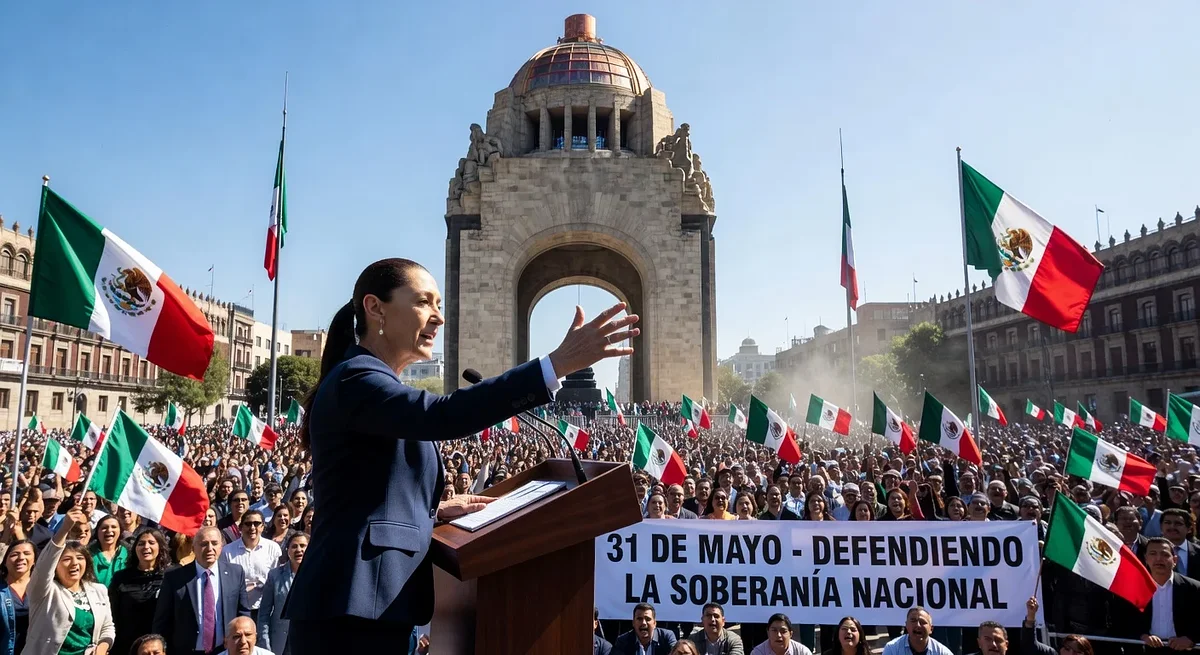
President Claudia Sheinbaum led a rally in Mexico City's Zócalo to mark seven years of the Fourth Transformation, with over 600,000 attendees. In her speech, she highlighted achievements in economy, health, and sovereignty, and reaffirmed her commitment to republican austerity. The event featured messages of unity and defense against disinformation campaigns.


이 웹사이트는 쿠키를 사용합니다

사이트를 개선하기 위해 분석을 위한 쿠키를 사용합니다. 자세한 내용은 개인정보 보호 정책을 읽으세요.
거부