Sinaloa grapples with cartel factions' war

For nearly a year and a half, Sinaloa has endured an armed conflict between Sinaloa Cartel factions, resulting in hundreds of victims and severe economic fallout. Civilians are caught in the crossfire amid governmental shortcomings. Analysts urge recognizing it as a war to rethink security approaches.

Columnist René Delgado writes in El Financiero that Sinaloa, especially Culiacán and other areas, has been at war since September 2024. Two Sinaloa Cartel factions clash, overwhelming the Mexican state despite Armed Forces' efforts. Civilians are ensnared in the crossfire and hampered by the 'mismanagement' of Governor Rubén Rocha Moya, criticized for negligence.

The toll is severe: hundreds of intentional homicides in 2025 exceed 2024 figures, with rising disappearances, particularly in Culiacán and Mazatlán. Economic losses top 50 billion pesos from late 2024 to mid-2025, stalling investments and activities. Collective kidnappings lead to clandestine graves, entrenching insecurity.

Delgado argues that avoiding the 'war' label blocks strategy overhauls. He advocates addressing political fronts by reforming prosecutor's offices, police, and governments, and severing politics-crime ties. He cites attacks on Movimiento Ciudadano deputies Sergio Torres Félix and Elizabeth Rafaela Montoya Ojeda by the 'Los Chapitos' faction, met with insufficient party responses.

While praising President Claudia Sheinbaum's security policy shift, he stresses the war demands more than military actions or U.S. pressures. 'The war in Sinaloa demands recognizing it as such and acting with greater resolve,' Delgado writes, underscoring political failure in the state.
Awọn iroyin ti o ni ibatan

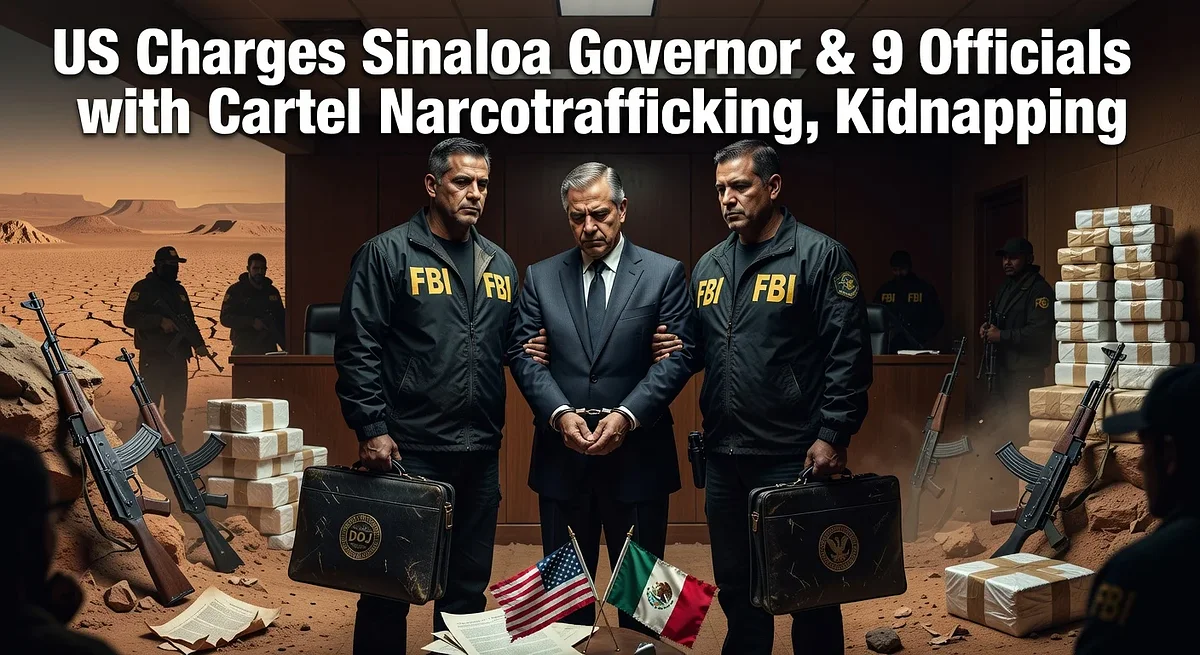
Dramatic illustration of Sinaloa Governor Rubén Rocha Moya arrested for alleged Sinaloa Cartel ties, featuring US agents, drugs, weapons, and flags.
Àwòrán tí AI ṣe

US charges Sinaloa governor and nine officials with cartel ties

Ti AI ṣe iroyin Àwòrán tí AI ṣe

The US Department of Justice charged Sinaloa Governor Rubén Rocha Moya and nine other officials on April 29 with conspiring with Los Chapitos of the Sinaloa Cartel to traffic narcotics into the US in exchange for bribes. Charges include narcotrafficking, weapons possession, and kidnapping resulting in death. Mexican authorities are reviewing extradition requests lacking attached evidence.

An armed attack on two Movimiento Ciudadano deputies in Culiacán, Sinaloa, on January 28, 2026, left Sergio Torres in grave condition and Elizabeth Montoya with serious injuries, including the loss of an eye. Federal authorities attribute the assault to a cell of Los Chapitos, a faction of the Sinaloa Cartel. The government has deployed operations and reported detentions to clarify the facts.

Ti AI ṣe iroyin

During President Claudia Sheinbaum's morning press conference, Security Secretary Omar García Harfuch acknowledged that authorities failed to prevent two recent violent attacks in Guanajuato, including a massacre at a soccer field in Salamanca and an incident at a public park that injured eight minors. However, he stated that such events have decreased compared to the previous administration and highlighted arrests and seizures against organized crime.

Former DIAN director and presidential precandidate Luis Carlos Reyes criticized Colombia's fiscal crisis and proposed precise state spending reductions, targeting contraband and illicit economies. In an interview with LA NACIÓN, he emphasized applying existing regulations instead of new taxes. He also questioned the 'Total Peace' policy and called for bolstering security and political transparency ahead of the 2026 elections.

Ti AI ṣe iroyin

Congressman Cristian Garcés criticized authorities' inaction on recent land invasions in north Cali's hills, in areas like Chipichape and Golondrinas. He accused mafias possibly linked to organized crime and pointed to institutional failures, including potential corruption cases. He called for coordinated intervention by multiple agencies to halt the issue.

Mexican armed forces killed Nemesio Oseguera Cervantes, alias El Mencho, leader of the Jalisco New Generation Cartel, in an operation in Tapalpa, Jalisco, last Sunday. This strike marks the most significant blow against a Mexican cartel in history. The action comes amid U.S. pressures and raises concerns over potential violent responses from the criminal group.

Ti AI ṣe iroyin

The killing of Jalisco New Generation Cartel leader Nemesio “El Mencho” Oseguera Cervantes has sparked violence in Guadalajara, prompting worries about safety for upcoming 2026 FIFA World Cup matches. FIFA expressed full confidence in host nations Mexico, Canada, and the United States, while Mexican officials pledged enhanced security. Local residents and experts highlighted potential disruptions to tourism and events in Jalisco state.


Ojú-ìwé yìí nlo kuki

A nlo kuki fun itupalẹ lati mu ilọsiwaju wa. Ka ìlànà àṣírí wa fun alaye siwaju sii.
Kọ