China's beef quotas create opportunities for Colombia

China has announced annual quotas and a 55% tariff on beef imports exceeding limits for South American suppliers like Argentina, Brazil, and Uruguay, but Colombia is exempt due to its small market share.

The policy, effective from January 2026, aims to protect Chinese local producers. Total quotas will be 2.69 million tons in 2026, rising to 2.74 million in 2027 and 2.8 million in 2028. Shipments exceeding these limits will face the punitive 55% tariff.

Colombia, with a historical share under 3% of Chinese imports, is not subject to these restrictions. This provides a competitive edge, according to sector experts. José Félix Lafaurie Rivera, president of Fedegan, stated: “China is today one of the most relevant markets for South American beef. Therefore, any adjustment in its trade rules has immediate effects on prices, volumes, and export strategies. In this new scenario, Colombia emerges as a smaller but potentially benefiting actor”.

Dane data shows that from January to October 2025, China imported 16,006 tons of Colombian beef worth US$77.6 million, a record surpassing the 10,650 tons for all of 2024 (US$41.3 million). This market accounted for 51.4% of Colombia's beef exports in that period.

Augusto Beltrán Segrera from Fedegan said: “This is good news for Colombia. They don't impose a tariff on us because historically we have less than 3% of the imports, so the tariff doesn't apply to Colombia. Thus, with this news, we will have a competitive advantage because Colombian products won't have additional tariffs”.

Beltrán estimates Colombia could export up to 50,000 tons to China, tripling current volumes, depending on domestic prices.
Related Articles

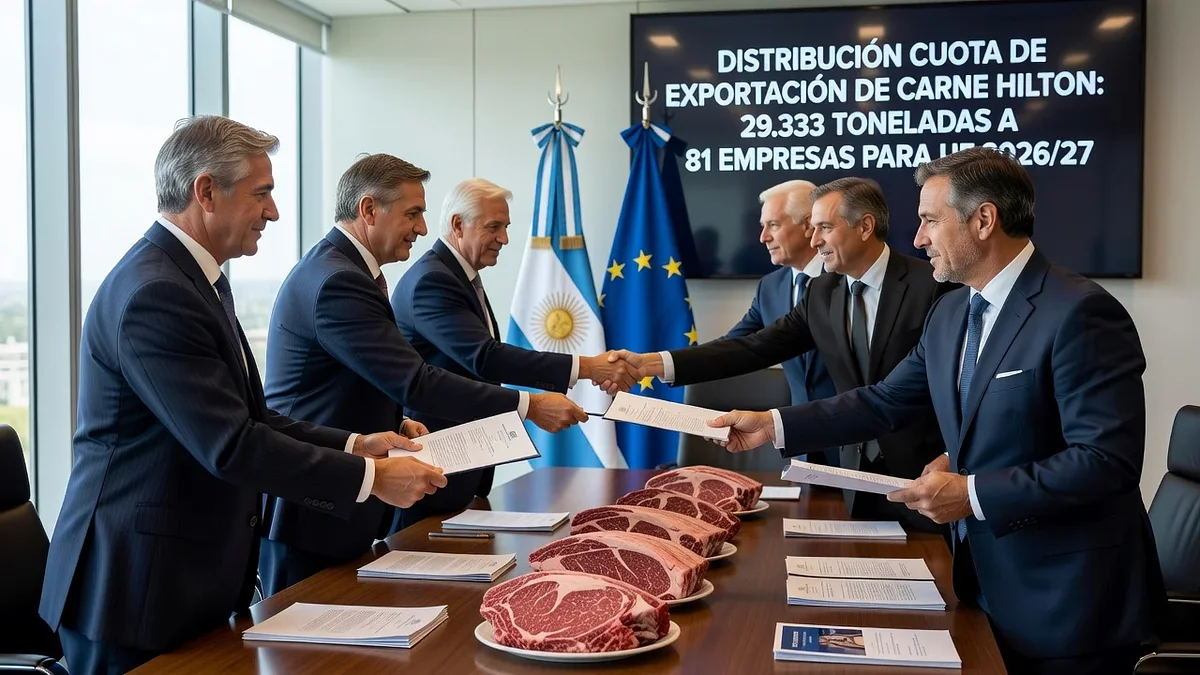
Argentine and US officials shake hands sealing trade deal expanding beef exports to 100,000 tons.
Image generated by AI

Argentina signs trade agreement with the United States

Reported by AI Image generated by AI

Foreign Minister Pablo Quirno announced a trade agreement between Argentina and the United States that expands the beef export quota to 100,000 tons and removes tariff barriers in key sectors. The deal aims to strengthen bilateral economic ties and could boost exports by up to $1,013 million. The agricultural sector, particularly meat exporters, hailed the pact as a major step forward.

The People's Republic of China announced safeguard measures for beef imports starting January 1, 2026, with country-specific quotas and 55% tariffs on excess volumes. These will affect Argentina, with limits of 511,000 tons in 2026, 521,000 in 2027, and 532,000 in 2028. Experts estimate the initial impact will be limited but could encourage market diversification.

Reported by AI

Building on China's safeguard measures announced January 1, 2026, which impose country-specific beef import quotas through 2028 with 55% tariffs on excess volumes (12.5% within limits), Argentina receives 511,000 tons—exceeding 2025 exports by about 100,000 tons—positioning it and Uruguay as key beneficiaries compared to Brazil and Australia. This eases concerns in Argentina's cattle sector, supporting growth without severe restrictions, though capping major expansions.

Ecuador's President Daniel Noboa announced a 30% security tariff on imports from Colombia, effective February 1, 2026, citing a lack of cooperation in border control against narcotrafficking and illegal mining. The measure has drawn immediate backlash from Colombian business groups and the government, who view it as a breach of the Andean Community of Nations (CAN) agreements. It is expected to significantly impact bilateral trade, worth billions of dollars annually.

Reported by AI

Huila's tilapia exports to the United States suffered a major blow in 2025 from a 10% tariff imposed by the US, forcing producers to lower prices to retain market share. Despite higher shipment volumes, sector incomes fell short of expectations. Experts note the companies' resilience but warn of ongoing challenges.

President Donald Trump announced an increase in temporary tariffs on US imports from 10% to 15%, following a setback from the Supreme Court. This global measure will affect key sectors of Colombian exports, such as coffee, flowers, and oil, according to AmCham Colombia's analysis. While some products may be exempt, nearly one-third of the export basket will face the additional surcharge.

Reported by AI

Bilateral trade between Chile and China reached $61.66 billion in 2024, an 8.6-fold increase from 2006. Chilean cherries have emerged as a key symbol of this partnership, with exports nearing $3.3 billion in the 2024/25 season. Industry leaders remain optimistic despite a slight volume decline.


This website uses cookies

We use cookies for analytics to improve our site. Read our privacy policy for more information.
Decline