China's beef quotas create opportunities for Colombia

China has announced annual quotas and a 55% tariff on beef imports exceeding limits for South American suppliers like Argentina, Brazil, and Uruguay, but Colombia is exempt due to its small market share.

The policy, effective from January 2026, aims to protect Chinese local producers. Total quotas will be 2.69 million tons in 2026, rising to 2.74 million in 2027 and 2.8 million in 2028. Shipments exceeding these limits will face the punitive 55% tariff.

Colombia, with a historical share under 3% of Chinese imports, is not subject to these restrictions. This provides a competitive edge, according to sector experts. José Félix Lafaurie Rivera, president of Fedegan, stated: “China is today one of the most relevant markets for South American beef. Therefore, any adjustment in its trade rules has immediate effects on prices, volumes, and export strategies. In this new scenario, Colombia emerges as a smaller but potentially benefiting actor”.

Dane data shows that from January to October 2025, China imported 16,006 tons of Colombian beef worth US$77.6 million, a record surpassing the 10,650 tons for all of 2024 (US$41.3 million). This market accounted for 51.4% of Colombia's beef exports in that period.

Augusto Beltrán Segrera from Fedegan said: “This is good news for Colombia. They don't impose a tariff on us because historically we have less than 3% of the imports, so the tariff doesn't apply to Colombia. Thus, with this news, we will have a competitive advantage because Colombian products won't have additional tariffs”.

Beltrán estimates Colombia could export up to 50,000 tons to China, tripling current volumes, depending on domestic prices.
Articoli correlati

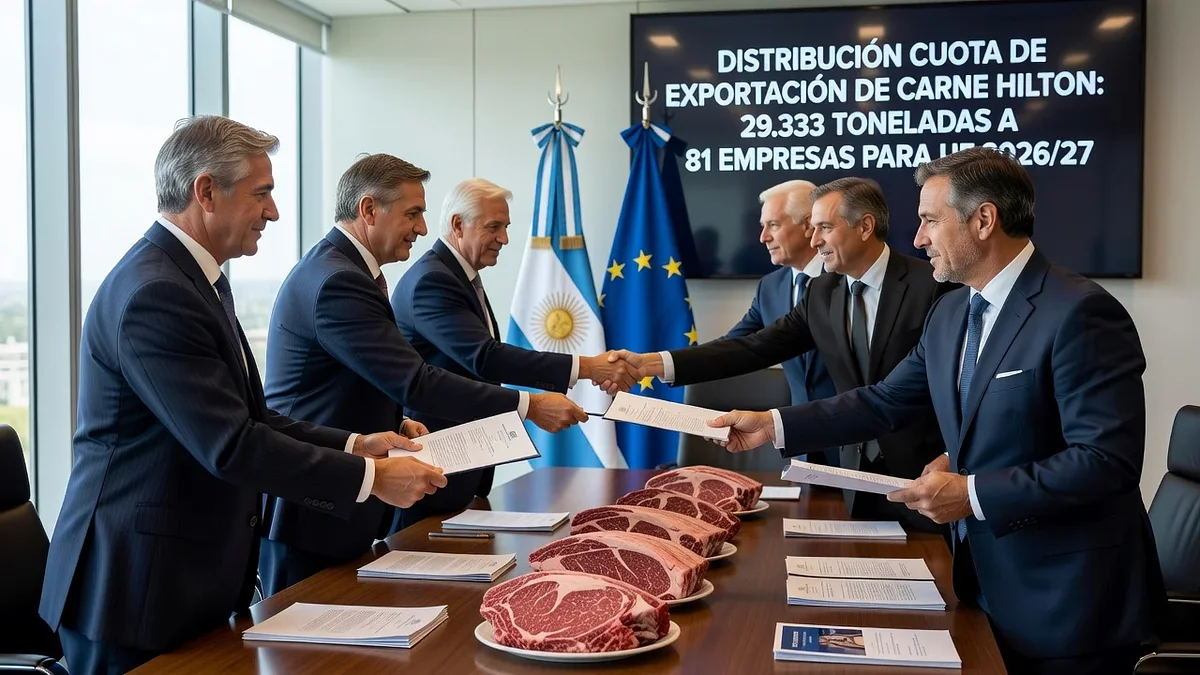
Argentine and US officials shake hands sealing trade deal expanding beef exports to 100,000 tons.
Immagine generata dall'IA

L'Argentina firma accordo commerciale con gli Stati Uniti

Riportato dall'IA Immagine generata dall'IA

Il ministro degli Esteri Pablo Quirno ha annunciato un accordo commerciale tra Argentina e Stati Uniti che amplia la quota di esportazione di manzo a 100.000 tonnellate e rimuove le barriere tariffarie in settori chiave. L'accordo mira a rafforzare i legami economici bilaterali e potrebbe incrementare le esportazioni fino a 1,013 miliardi di dollari. Il settore agricolo, in particolare gli esportatori di carne, ha accolto il patto come un passo importante avanti.

La Repubblica popolare cinese ha annunciato misure di salvaguardia per le importazioni di manzo a partire dal 1 gennaio 2026, con quote specifiche per paese e tariffe del 55% sui volumi eccedenti. Queste colpiranno l’Argentina, con limiti di 511.000 tonnellate nel 2026, 521.000 nel 2027 e 532.000 nel 2028. Gli esperti stimano che l’impatto iniziale sarà limitato ma potrebbe favorire la diversificazione dei mercati.

Riportato dall'IA

Basandosi sulle misure di salvaguardia annunciate dalla Cina il 1º gennaio 2026, che impongono quote di importazione di manzo specifiche per paese fino al 2028 con tariffe del 55% sui volumi eccedenti (12,5% entro i limiti), l'Argentina riceve 511.000 tonnellate — superando le esportazioni del 2025 di circa 100.000 tonnellate —, posizionandola e l'Uruguay come principali beneficiari rispetto a Brasile e Australia. Ciò attenua le preoccupazioni nel settore bovino argentino, sostenendo la crescita senza restrizioni severe, sebbene limiti le espansioni maggiori.

Ecuador's President Daniel Noboa announced a 30% security tariff on imports from Colombia, effective February 1, 2026, citing a lack of cooperation in border control against narcotrafficking and illegal mining. The measure has drawn immediate backlash from Colombian business groups and the government, who view it as a breach of the Andean Community of Nations (CAN) agreements. It is expected to significantly impact bilateral trade, worth billions of dollars annually.

Riportato dall'IA

Huila's tilapia exports to the United States suffered a major blow in 2025 from a 10% tariff imposed by the US, forcing producers to lower prices to retain market share. Despite higher shipment volumes, sector incomes fell short of expectations. Experts note the companies' resilience but warn of ongoing challenges.

President Donald Trump announced an increase in temporary tariffs on US imports from 10% to 15%, following a setback from the Supreme Court. This global measure will affect key sectors of Colombian exports, such as coffee, flowers, and oil, according to AmCham Colombia's analysis. While some products may be exempt, nearly one-third of the export basket will face the additional surcharge.

Riportato dall'IA

Bilateral trade between Chile and China reached $61.66 billion in 2024, an 8.6-fold increase from 2006. Chilean cherries have emerged as a key symbol of this partnership, with exports nearing $3.3 billion in the 2024/25 season. Industry leaders remain optimistic despite a slight volume decline.


Questo sito web utilizza i cookie

Utilizziamo i cookie per l'analisi per migliorare il nostro sito. Leggi la nostra politica sulla privacy per ulteriori informazioni.
Rifiuta