Exclusion from investment code identified as main obstacle to Ethiopia's creative industry

Stakeholders say the main obstacle facing Ethiopia's cultural and creative industries is the sector's exclusion from the national investment code rather than a lack of government funding.

Stakeholders in Ethiopia's cultural and creative industries have identified the sector's exclusion from the national investment code as its main obstacle. They argue that this prevents the industry from emerging as a driver of foreign exchange and jobs despite its potential.

Selam Ethiopia handed over a five-year study under the Connect for Culture Africa project to a government body. The study supports an African commitment for member states to allocate at least 1 percent of annual budgets to culture and the arts.

Sisay Mengiste, program director of Selam Ethiopia, said the organization has worked with federal and regional stakeholders for 21 years. Hirut Kassa, head of the Addis Ababa Culture and Arts Bureau, said applying the same rules as commodity trade has slowed growth.

Nafisa Al-Mahdi, state minister at the Ministry of Culture and Sports, said culture and the arts are pillars of the economy. She noted that the government is preparing and implementing policy frameworks.
Relaterede artikler

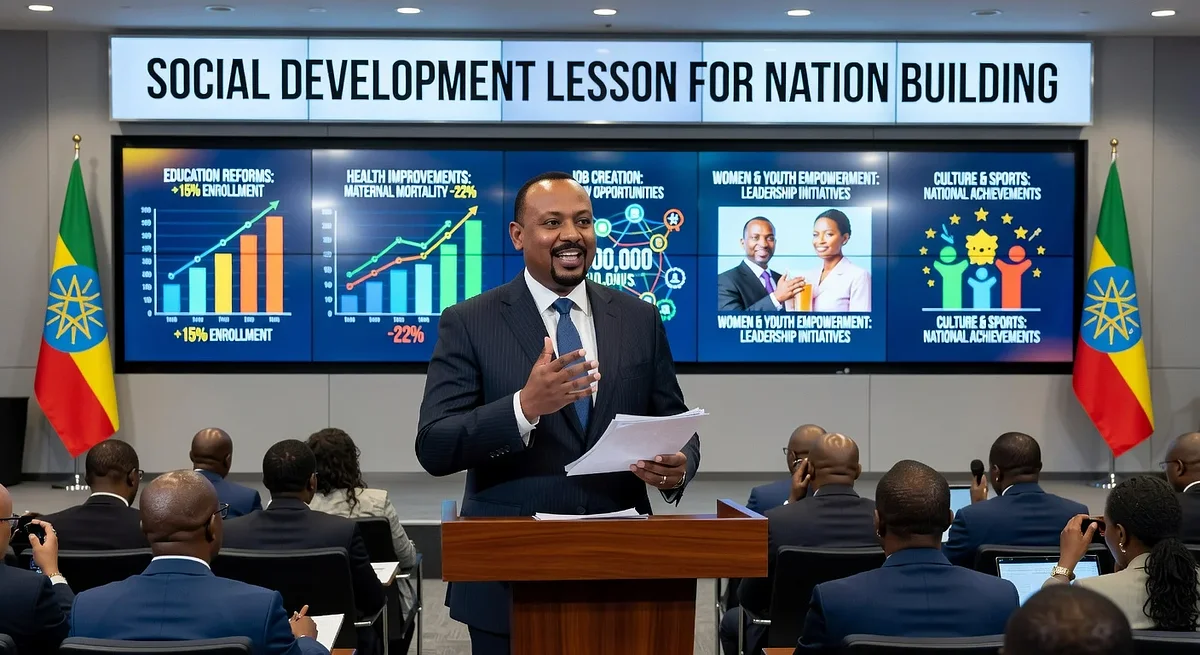
Prime Minister Abiy Ahmed highlights Ethiopia's social sector achievements at Addis Ababa briefing.
Billede genereret af AI

Prime Minister Abiy Ahmed highlights Ethiopia's social sector achievements at Addis Ababa briefing

Rapporteret af AI Billede genereret af AI

Prime Minister Dr. Abiy Ahmed presented major outcomes in Ethiopia's social and economic sectors at a briefing in Addis Ababa on April 28, 2026 (Miyazya 20, 2018 E.C.), themed 'Social development lesson for nation building.' The event reviewed comprehensive reforms and achievements in education, health, job creation, women's and youth empowerment, culture, sports, and more, emphasizing their role in national growth.

Ethiopia's state minister of innovation and technology, Belete Mola, stated that higher education institutions will urge graduates to demonstrate their creative skills through broad job opportunities. This came during a discussion at Wollo University focusing on science and technology policy, Digital Ethiopia 2030, and startup policy.

Rapporteret af AI

Indonesia's government is pushing for creative economy offices in 22 provinces and about 70 regencies or cities to bolster the creative industry ecosystem. Creative Economy Minister Teuku Riefky Harsya stated this after meeting creative business actors in Jakarta. The initiative aims to expand support access for creative entrepreneurs.

Ambassadors and diplomats from various countries visited special economic zones in Ethiopia to examine investment opportunities and industrial developments.

Rapporteret af AI

The chief executive of Egypt's Micro, Small and Medium Enterprise Development Agency confirmed an integrated plan to develop clusters for traditional and heritage crafts in cooperation with relevant authorities.

Finance Minister Ahmed Shide said international financial institutions must improve their practices to help countries prevent crises. He made the remarks at an ongoing global partnership forum in London.

Rapporteret af AI

Ethiopia has saved billions of dollars through its homegrown economic policy in the manufacturing sector. In just the past nine months, domestic production substituted imports worth 4.85 billion dollars, while exports reached 433 million dollars. Data from the Ministry of Industry confirms these gains.

Dette websted bruger cookies

Vi bruger cookies til analyse for at forbedre vores side. Læs vores privatlivspolitik for mere information.
Afvis