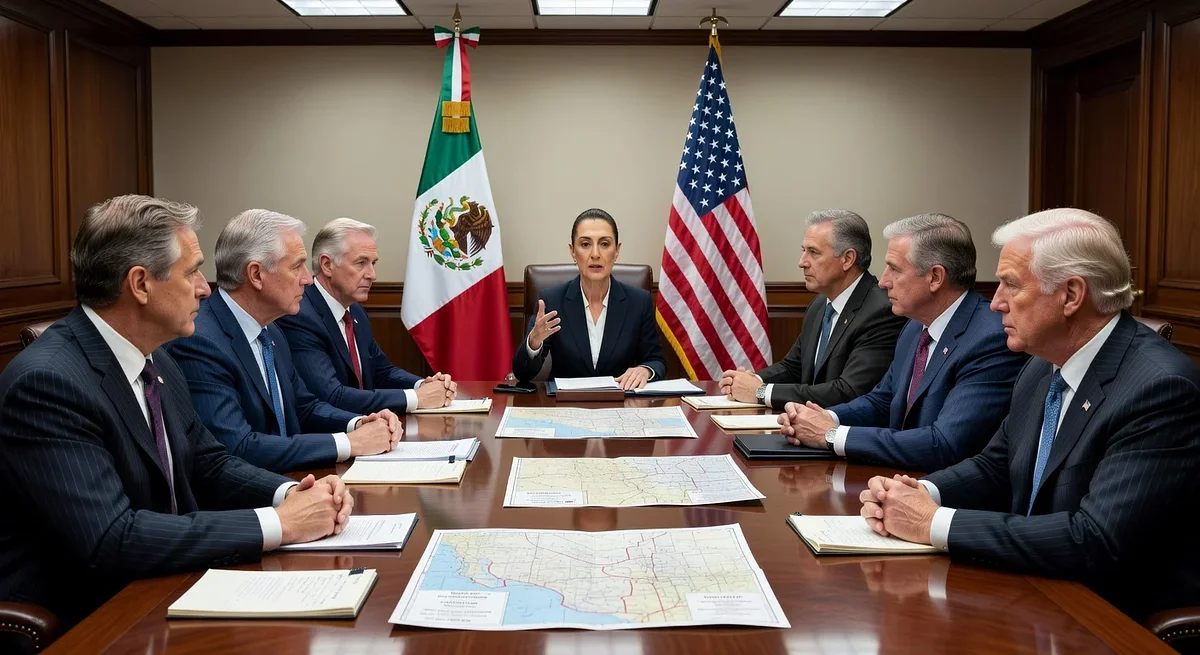
Composite illustration of Mexican President Claudia Sheinbaum and U.S. President Donald Trump engaged in a cordial phone discussion on T-MEC progress, security, and trade.
Image generated by AI

Sheinbaum and Trump hold productive follow-up call on T-MEC progress, security, and trade

Image generated by AI

Mexican President Claudia Sheinbaum and U.S. President Donald Trump discussed advances in the T-MEC review, bilateral security, narcotrafficking, and trade during a phone call on January 29, 2026. Described as productive and cordial, the conversation—a follow-up to their January 12 talk—saw Trump praise Sheinbaum as a 'wonderful and intelligent leader' amid plans for future meetings.

The January 29, 2026, phone call between Presidents Claudia Sheinbaum and Donald Trump, requested by the U.S. leader, covered key commercial and security issues. Sheinbaum described the exchange as 'productive and cordial,' stating on social media: 'We continue advancing on commercial topics and bilateral relations. We agreed that both teams will keep working jointly.' Trump echoed the positivity on Truth Social, posting: 'Mexico has a wonderful and intelligent leader. They should be very happy about it!' The leaders also briefly exchanged greetings with Melania Trump.

Discussions centered on the United States-Mexico-Canada Agreement (T-MEC/USMCA) review, set for July, with over 90% progress on 54 topics. Economy Secretary Marcelo Ebrard, visiting Washington and meeting U.S. officials including Howard Lutnick and Trade Representative Jamieson Greer, indicated the treaty's core structure would remain intact via 'side letters or additional protocols' rather than full renegotiation. The U.S. pushes for structural reforms, such as expanded rules of origin in automotive and other industries, while Mexico advocates symmetric labor procedures.

On security, both sides noted progress in combating narcotrafficking and border issues, with plans for future talks and meetings. However, Sheinbaum firmly rejected U.S. military operations on Mexican soil: 'We will never accept joint operations from the United States... operations on our territory are by Mexican forces.' She denied talks on extraditions, the Ryan Wedding case, or oil shipments to Cuba.

The call reflects improving ties amid past frictions. Last May, Trump urged Sheinbaum to allow U.S. troops against cartels, but she refused, prompting criticism. In August, she ruled out any invasion despite U.S. plans targeting cartels. Trade tensions arose from U.S. tariffs on Mexico for fentanyl flows, later paused during T-MEC negotiations, with many goods protected under the pact.

Ebrard reiterated that 'the core structure of the treaty will go forward,' signaling optimism for continued collaboration.
What people are saying

Reactions on X to the January 29, 2026, phone call between Mexican President Claudia Sheinbaum and U.S. President Donald Trump are predominantly positive and neutral. Official accounts from both leaders describe the discussion as productive and cordial, covering T-MEC review, trade, security, and narcotrafficking. Trump praised Sheinbaum as a 'wonderful and intelligent leader,' prompting supportive commentary from Mexican media and users, with some noting political satisfaction amid opposition criticism.

Related Articles

Split-screen illustration of Presidents Sheinbaum and Trump in a phone call defending Mexican sovereignty amid US intervention threats.
Image generated by AI

Sheinbaum holds 15-minute call with Trump on Mexican sovereignty

Reported by AI Image generated by AI

Mexican President Claudia Sheinbaum held a brief 15-minute phone call with US President Donald Trump on January 12, 2026, to defend Mexico's sovereignty amid threats of military intervention against drug cartels. Sheinbaum rejected the need for US troops and highlighted existing bilateral cooperation. Trump also inquired about Mexico's stance on the situation in Venezuela.

President Claudia Sheinbaum defended progress in bilateral security cooperation with the United States, highlighting strong results and demanding mutual respect and shared responsibility. This comes in response to criticisms from the US State Department calling for concrete results against drug trafficking. Additionally, the Mexican foreign minister and his counterpart agreed to meetings to strengthen joint actions.

Reported by AI

President Claudia Sheinbaum denied discussing the extradition of Mexican politicians linked to narcotrafficking with Donald Trump, responding to a Wall Street Journal report. In her morning press conference on January 14, 2026, she also declined to debate Trump's statements calling the USMCA irrelevant.

The 2026 review of the Mexico, United States, and Canada Agreement (T-MEC) is shaping up as a complex process fraught with uncertainty, according to experts. The event will define commercial certainty for North America, with risks of U.S. protectionism and potential structural changes. Mexico faces challenges in sectors like energy, labor, and migration.

Reported by AI

US Secretary of State Marco Rubio praised Mexico's cooperation on security under President Claudia Sheinbaum, noting that the Mexican government is doing more than ever on this issue. Rubio contrasted this collaboration with Venezuela's lack of cooperation, accusing it of allying with criminal groups. The statement came during a press conference on border security and anti-drug trafficking plans under the Trump administration.

In remarks following her disclosures on historical debt relief, President Claudia Sheinbaum emphasized that energy sector deals with Cuba are fully compliant with legal standards, aiming to address concerns over their legitimacy.

Reported by AI

Following Presidents Gustavo Petro and Donald Trump's January 7 phone call and invitation, Colombia's Foreign Minister Laura Sarabia spoke with U.S. Secretary of State Marco Rubio on January 23 to coordinate their February 3 White House meeting. Discussions focused on combating organized crime, regional security, and economic opportunities, reaffirming bilateral cooperation amid past tensions.


This website uses cookies

We use cookies for analytics to improve our site. Read our privacy policy for more information.
Decline