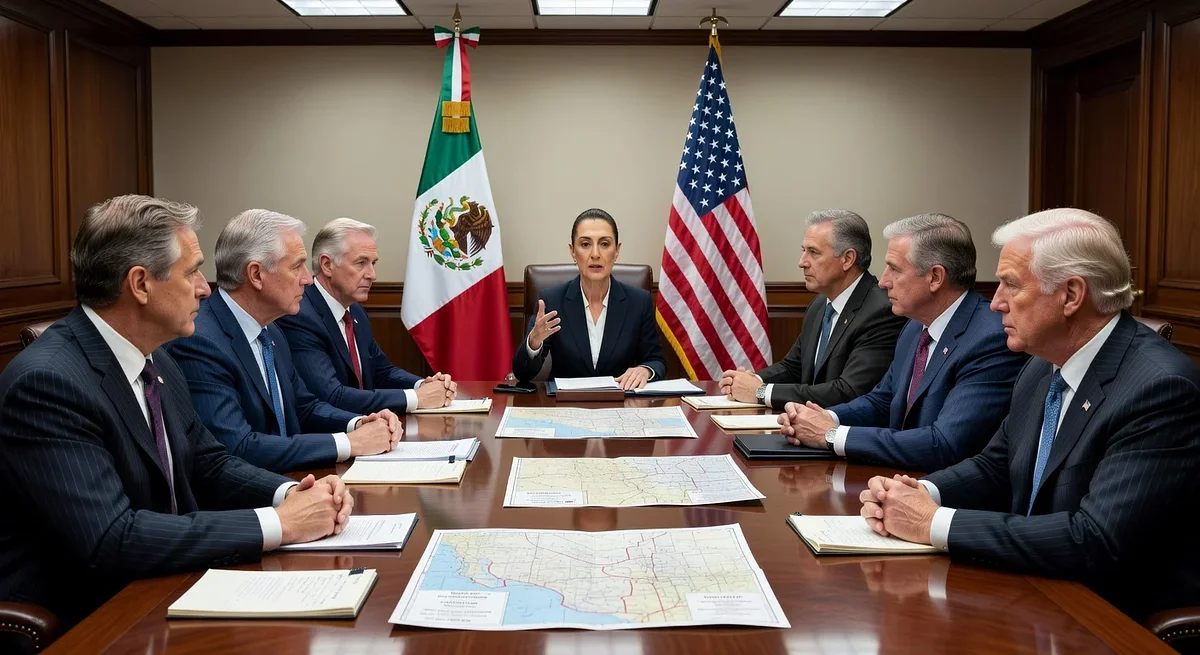
Composite illustration of Mexican President Claudia Sheinbaum and U.S. President Donald Trump engaged in a cordial phone discussion on T-MEC progress, security, and trade.
صورة مولدة بواسطة الذكاء الاصطناعي

Sheinbaum and Trump hold productive follow-up call on T-MEC progress, security, and trade

صورة مولدة بواسطة الذكاء الاصطناعي

Mexican President Claudia Sheinbaum and U.S. President Donald Trump discussed advances in the T-MEC review, bilateral security, narcotrafficking, and trade during a phone call on January 29, 2026. Described as productive and cordial, the conversation—a follow-up to their January 12 talk—saw Trump praise Sheinbaum as a 'wonderful and intelligent leader' amid plans for future meetings.

The January 29, 2026, phone call between Presidents Claudia Sheinbaum and Donald Trump, requested by the U.S. leader, covered key commercial and security issues. Sheinbaum described the exchange as 'productive and cordial,' stating on social media: 'We continue advancing on commercial topics and bilateral relations. We agreed that both teams will keep working jointly.' Trump echoed the positivity on Truth Social, posting: 'Mexico has a wonderful and intelligent leader. They should be very happy about it!' The leaders also briefly exchanged greetings with Melania Trump.

Discussions centered on the United States-Mexico-Canada Agreement (T-MEC/USMCA) review, set for July, with over 90% progress on 54 topics. Economy Secretary Marcelo Ebrard, visiting Washington and meeting U.S. officials including Howard Lutnick and Trade Representative Jamieson Greer, indicated the treaty's core structure would remain intact via 'side letters or additional protocols' rather than full renegotiation. The U.S. pushes for structural reforms, such as expanded rules of origin in automotive and other industries, while Mexico advocates symmetric labor procedures.

On security, both sides noted progress in combating narcotrafficking and border issues, with plans for future talks and meetings. However, Sheinbaum firmly rejected U.S. military operations on Mexican soil: 'We will never accept joint operations from the United States... operations on our territory are by Mexican forces.' She denied talks on extraditions, the Ryan Wedding case, or oil shipments to Cuba.

The call reflects improving ties amid past frictions. Last May, Trump urged Sheinbaum to allow U.S. troops against cartels, but she refused, prompting criticism. In August, she ruled out any invasion despite U.S. plans targeting cartels. Trade tensions arose from U.S. tariffs on Mexico for fentanyl flows, later paused during T-MEC negotiations, with many goods protected under the pact.

Ebrard reiterated that 'the core structure of the treaty will go forward,' signaling optimism for continued collaboration.
ما يقوله الناس

Reactions on X to the January 29, 2026, phone call between Mexican President Claudia Sheinbaum and U.S. President Donald Trump are predominantly positive and neutral. Official accounts from both leaders describe the discussion as productive and cordial, covering T-MEC review, trade, security, and narcotrafficking. Trump praised Sheinbaum as a 'wonderful and intelligent leader,' prompting supportive commentary from Mexican media and users, with some noting political satisfaction amid opposition criticism.

مقالات ذات صلة

Split-screen illustration of Presidents Sheinbaum and Trump in a phone call defending Mexican sovereignty amid US intervention threats.
صورة مولدة بواسطة الذكاء الاصطناعي

Sheinbaum holds 15-minute call with Trump on Mexican sovereignty

من إعداد الذكاء الاصطناعي صورة مولدة بواسطة الذكاء الاصطناعي

Mexican President Claudia Sheinbaum held a brief 15-minute phone call with US President Donald Trump on January 12, 2026, to defend Mexico's sovereignty amid threats of military intervention against drug cartels. Sheinbaum rejected the need for US troops and highlighted existing bilateral cooperation. Trump also inquired about Mexico's stance on the situation in Venezuela.

President Claudia Sheinbaum defended progress in bilateral security cooperation with the United States, highlighting strong results and demanding mutual respect and shared responsibility. This comes in response to criticisms from the US State Department calling for concrete results against drug trafficking. Additionally, the Mexican foreign minister and his counterpart agreed to meetings to strengthen joint actions.

من إعداد الذكاء الاصطناعي

President Claudia Sheinbaum denied discussing the extradition of Mexican politicians linked to narcotrafficking with Donald Trump, responding to a Wall Street Journal report. In her morning press conference on January 14, 2026, she also declined to debate Trump's statements calling the USMCA irrelevant.

Mexican President Claudia Sheinbaum downplayed Donald Trump's statements on potential military operations in Mexico to fight drug cartels. She stated it would not be necessary and that Mexico, as a sovereign nation, would never accept foreign intervention. She emphasized the current understanding on security matters with the United States.

من إعداد الذكاء الاصطناعي

Following Congress's approval of tariffs on over 1,000 Asian imports, President Claudia Sheinbaum announced ongoing dialogues with China, India, and South Korea to evaluate effects and seek cooperative solutions, aiming to safeguard Mexico's industry without sparking tensions. The measures, set for January 2026, target products harming local producers and jobs.

Mexico's President Claudia Sheinbaum, U.S. President Donald Trump, and Canada's Prime Minister Mark Carney will hold brief meetings during the FIFA 2026 World Cup draw in Washington this Friday. While speculation surrounds potential economic talks on tariffs and the T-MEC review, the Canadian government confirms the focus will be solely on football. Business leaders from all three countries urge strengthening the trade agreement amid expiration threats.

من إعداد الذكاء الاصطناعي

Canadian Prime Minister Mark Carney appointed Janice Charette as chief trade negotiator with the United States ahead of the T-MEC review this summer. Meanwhile, Mexico and Canada agreed on a bilateral action plan to bolster their trade and investments amid tensions with the Donald Trump administration. These moves aim to prepare both countries for the North American trade agreement review process.


يستخدم هذا الموقع ملفات تعريف الارتباط

نستخدم ملفات تعريف الارتباط للتحليلات لتحسين موقعنا. اقرأ سياسة الخصوصية الخاصة بنا سياسة الخصوصية لمزيد من المعلومات.
رفض