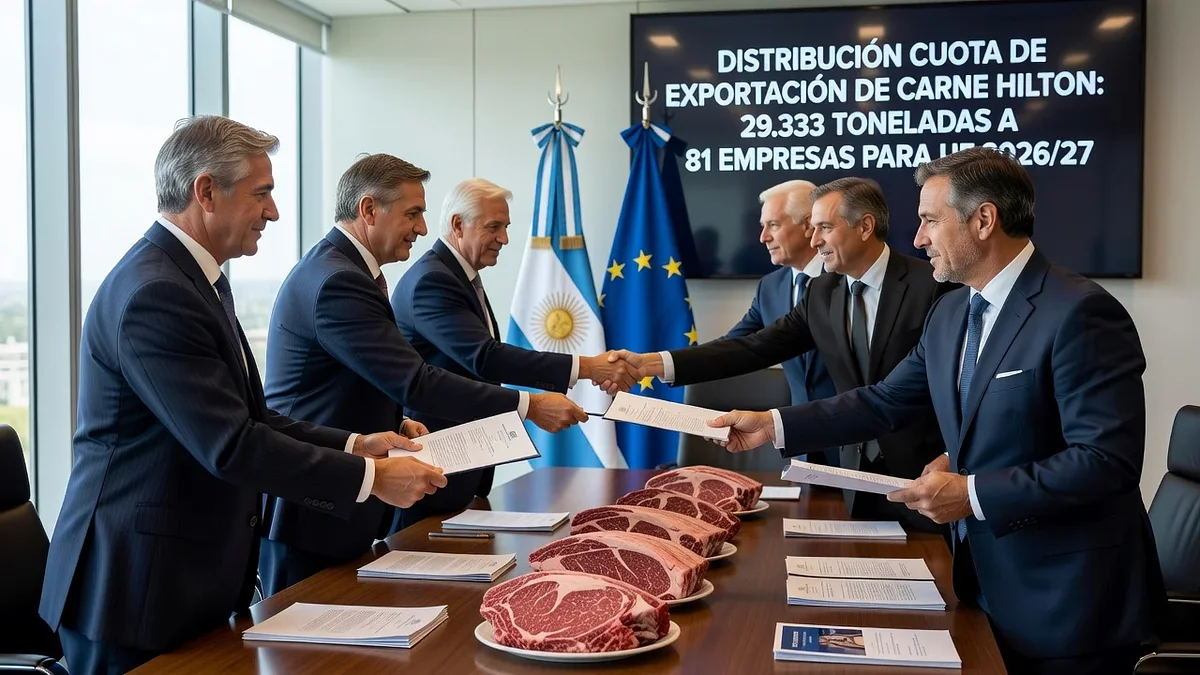
Argentine and US officials shake hands sealing trade deal expanding beef exports to 100,000 tons.
AI에 의해 생성된 이미지

Argentina signs trade agreement with the United States

AI에 의해 생성된 이미지

Foreign Minister Pablo Quirno announced a trade agreement between Argentina and the United States that expands the beef export quota to 100,000 tons and removes tariff barriers in key sectors. The deal aims to strengthen bilateral economic ties and could boost exports by up to $1,013 million. The agricultural sector, particularly meat exporters, hailed the pact as a major step forward.

On February 5, 2026, Argentine Foreign Minister Pablo Quirno announced on social media a trade agreement with the United States, aimed at removing tariff barriers and expanding access to key markets. According to the Foreign Ministry statement, the pact will affect productive chains such as beef, steel, and aluminum, with official estimates of recovering $1,013 million in exports.

In the beef sector, the deal grants an expansion to 100,000 tons for preferential access to the U.S. market, adding 80,000 tons to the existing 20,000. "This ensures an additional 80,000 tons in 2026, which adds to the 20,000 tons our country already has, allowing an increase of nearly $800 million in Argentine beef exports," the ministry stated.

The Argentine Beef Exporters Consortium (Consorcio ABC) congratulated the government on the achievement, noting it as "the result of coordinated work between the public and private sectors." The group highlighted that, despite a challenging context due to reduced cattle supply, companies are committed to producing to meet the quota, generating income exceeding $700 million in 2026.

Amadeo Derito, president of the Angus Association, emphasized the U.S. market's value: "It is one of the markets that has grown the most in recent years, and this agreement allows us to enter with quality beef." He explained that a certification protocol homologated with the USDA enables exporting high-value cuts like ribeye and skirt steak.

In context, Argentine beef exports hit a record of $3.7 billion in 2025, with the United States contributing a 27% volume jump to 44,300 tons and $345 million. The agreement is seen as a phenomenon similar to China's previous role in volume, but with a focus on elevated prices.
사람들이 말하는 것

Reactions on X to Argentina's trade agreement with the US are polarized: the beef sector and supporters celebrate the quota expansion to 100,000 tons and projected export gains of up to $1B; critics label it a sovereignty giveaway favoring US imports; neutral posts detail terms and await congressional approval.

관련 기사

Argentine and U.S. diplomats shake hands over signed trade agreement in Washington, symbolizing tariff cuts and boosted beef exports.
AI에 의해 생성된 이미지

Argentina signs reciprocal trade agreement with United States

AI에 의해 보고됨 AI에 의해 생성된 이미지

The Argentine government signed a reciprocal trade and investment agreement with the United States, seen as a first step toward a potential free trade deal. Signed in Washington, the measure will eliminate tariffs on thousands of products and expand the beef export quota to 100,000 tons annually. Officials hailed the deal as a boost to the country's international integration.

Building on China's safeguard measures announced January 1, 2026, which impose country-specific beef import quotas through 2028 with 55% tariffs on excess volumes (12.5% within limits), Argentina receives 511,000 tons—exceeding 2025 exports by about 100,000 tons—positioning it and Uruguay as key beneficiaries compared to Brazil and Australia. This eases concerns in Argentina's cattle sector, supporting growth without severe restrictions, though capping major expansions.

AI에 의해 보고됨

The People's Republic of China announced safeguard measures for beef imports starting January 1, 2026, with country-specific quotas and 55% tariffs on excess volumes. These will affect Argentina, with limits of 511,000 tons in 2026, 521,000 in 2027, and 532,000 in 2028. Experts estimate the initial impact will be limited but could encourage market diversification.

The European Council approved the free trade agreement between the European Union and Mercosul on Friday (9), with support from 21 of the 27 member states, following negotiations started in 1999. Despite the progress, hurdles remain, including European Parliament approval and potential legal challenges from countries like France. Signing is scheduled for January 17 in Asunción, Paraguay.

AI에 의해 보고됨

Argentina's agroexport sector commended the progress made in 2025 under President Javier Milei's government, highlighting macroeconomic stabilization, predictability in exchange rates and inflation, and reductions in grain export duties. Gustavo Idígoras, head of CIARA and CEC, foresaw a more stable policy for 2026 benefiting agriculture. These steps produced positive signs amid a year of intense changes.

India and the United States have agreed to reduce US tariffs on Indian exports from 50% to 18% under a bilateral trade deal, boosting India's competitiveness. Commerce Minister Piyush Goyal assured Parliament that agriculture and dairy sectors are fully protected. The agreement removes punitive tariffs linked to India's Russian oil purchases.

AI에 의해 보고됨

The government has enabled higher ethanol blends in gasoline, sparking a debate in the agricultural sector over increased production, investments, and reduced import dependence. In San Francisco, Córdoba, a station for the state fleet was opened to boost biofuel use.


이 웹사이트는 쿠키를 사용합니다

사이트를 개선하기 위해 분석을 위한 쿠키를 사용합니다. 자세한 내용은 개인정보 보호 정책을 읽으세요.
거부