Ethiopia advances economic reforms for sustained growth

The Prosperity Party government is carrying out massive economic activities to maintain Ethiopia on a fast growth path and ensure broad public benefits.

The government has completed major projects including the Grand Ethiopian Renaissance Dam. The Green Legacy movement and urban modernization initiatives have also been implemented successfully.

Commercial law has been reformed after 60 years of service. Banking and capital market sectors have been opened to competition. Summer irrigation wheat production has enabled the country to achieve food self-sufficiency and opened doors for exports.

The economy recorded 9.2 percent growth in the 2017 budget year. Efforts are underway to push growth above 10.2 percent this year. The seven Guba Birhanat strategic projects, built at a cost of 30 billion dollars, have entered implementation.
Related Articles

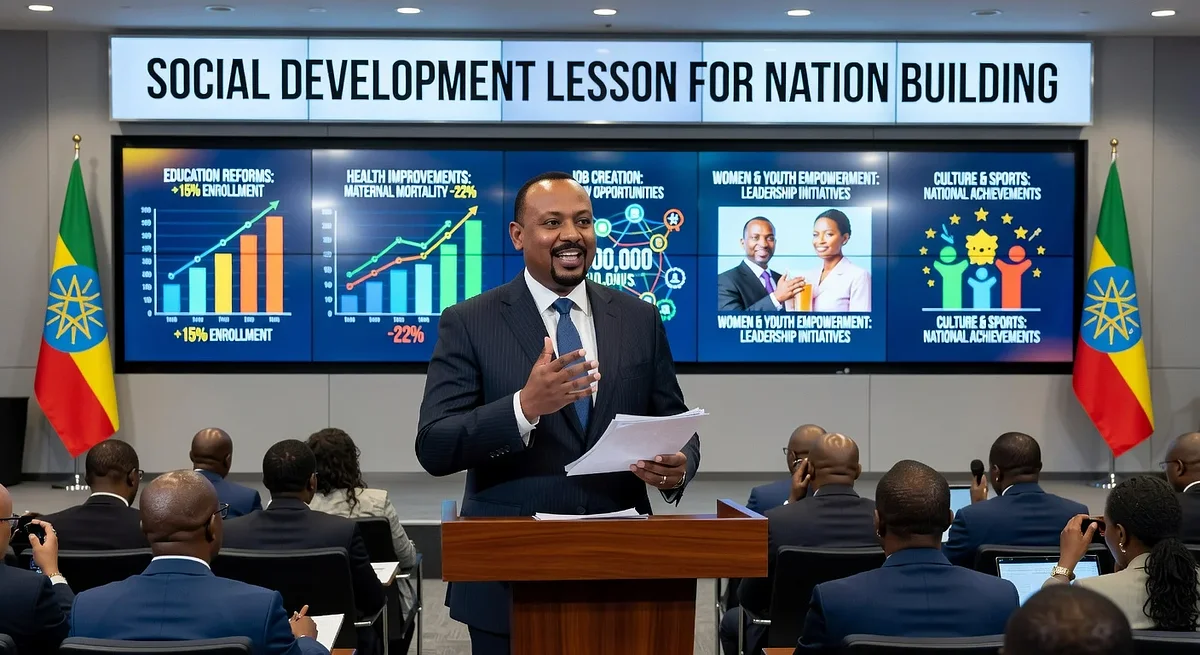
Dr. Fitsum Assefa announces Ethiopia's strong economic growth at Prosperity Party meeting in Addis Ababa.
Image generated by AI

Ethiopia registers strong economic growth, says Fitsum Assefa

Reported by AI Image generated by AI

The Prosperity Party's executive committee concluded its three-day regular meeting in Addis Ababa. Minister of Planning and Development Fitsum Assefa (Dr.) stated that Ethiopia is registering strong and quality economic growth. The meeting discussed national and party issues.

Deputy Prime Minister Temesgen Tiruneh began reviewing the third 100-day implementation report for Ethiopia's 2018 budget year with federal institution leaders today. He stated that Ethiopia has continued her renaissance journey through study since the start of internal reforms. The review highlights progress in governance, economy, and diplomacy.

Reported by AI

The World Bank states that Ethiopia's government development enterprises have shifted from budget burdens to job opportunities. A new report details reforms turning these entities into efficient revenue generators.

Deputy Prime Minister Temesgen Tiruneh stated at the launch of Ethiopia's Basic Infrastructure and Construction Week in Addis Ababa that ongoing national projects serve as reliable foundations for sustainable development. He emphasized the leadership principle of creativity, speed, and quality as key to Ethiopia's transformation. The event aligns with efforts toward national development visions.

Reported by AI

Ethiopia has saved billions of dollars through its homegrown economic policy in the manufacturing sector. In just the past nine months, domestic production substituted imports worth 4.85 billion dollars, while exports reached 433 million dollars. Data from the Ministry of Industry confirms these gains.

Minister of Planning and Economic Development Ahmed Rostom told parliament that Egypt’s economy is projected to grow by 5.4% by the end of fiscal year 2026/2027, rising to 6.8% by the end of the medium-term plan in 2029/2030. The government adopted a cautious growth scenario amid regional and global uncertainty.

Reported by AI

Egypt's Minister of Planning and Economic Development Ahmed Rostom said the national economy has withstood five major external shocks over the past six years, while delivering positive performance indicators. He spoke during a presentation of Egypt’s economic development plan at an American Chamber of Commerce conference. Rostom highlighted new initiatives to support startups and foster a better business environment.


This website uses cookies

We use cookies for analytics to improve our site. Read our privacy policy for more information.
Decline