L'Éthiopie fait progresser ses réformes économiques pour une croissance durable

Le gouvernement du Parti de la prospérité mène des activités économiques de grande envergure pour maintenir l'Éthiopie sur une trajectoire de croissance rapide et garantir des bénéfices pour l'ensemble de la population.

Le gouvernement a achevé des projets majeurs, notamment le Grand barrage de la Renaissance éthiopienne. Le mouvement « Green Legacy » et les initiatives de modernisation urbaine ont également été mis en œuvre avec succès.

Le droit commercial a été réformé après 60 ans d'existence. Les secteurs bancaire et des marchés financiers ont été ouverts à la concurrence. La production de blé irrigué en été a permis au pays d'atteindre l'autosuffisance alimentaire et a ouvert des portes aux exportations.

L'économie a enregistré une croissance de 9,2 pour cent au cours de l'exercice budgétaire 2017. Des efforts sont en cours pour porter la croissance au-delà de 10,2 pour cent cette année. Les sept projets stratégiques Guba Birhanat, construits pour un coût de 30 milliards de dollars, sont entrés en phase de mise en œuvre.
Articles connexes

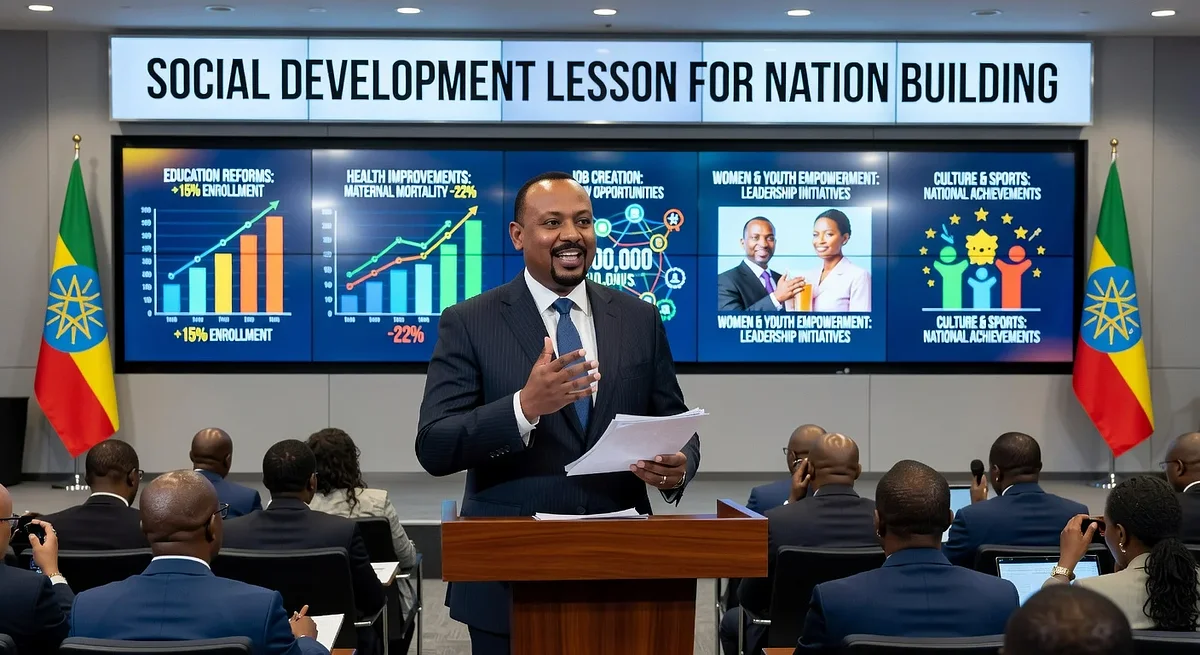
Dr. Fitsum Assefa announces Ethiopia's strong economic growth at Prosperity Party meeting in Addis Ababa.
Image générée par IA

Ethiopia registers strong economic growth, says Fitsum Assefa

Rapporté par l'IA Image générée par IA

The Prosperity Party's executive committee concluded its three-day regular meeting in Addis Ababa. Minister of Planning and Development Fitsum Assefa (Dr.) stated that Ethiopia is registering strong and quality economic growth. The meeting discussed national and party issues.

Deputy Prime Minister Temesgen Tiruneh began reviewing the third 100-day implementation report for Ethiopia's 2018 budget year with federal institution leaders today. He stated that Ethiopia has continued her renaissance journey through study since the start of internal reforms. The review highlights progress in governance, economy, and diplomacy.

Rapporté par l'IA

The World Bank states that Ethiopia's government development enterprises have shifted from budget burdens to job opportunities. A new report details reforms turning these entities into efficient revenue generators.

Deputy Prime Minister Temesgen Tiruneh stated at the launch of Ethiopia's Basic Infrastructure and Construction Week in Addis Ababa that ongoing national projects serve as reliable foundations for sustainable development. He emphasized the leadership principle of creativity, speed, and quality as key to Ethiopia's transformation. The event aligns with efforts toward national development visions.

Rapporté par l'IA

Ethiopia has saved billions of dollars through its homegrown economic policy in the manufacturing sector. In just the past nine months, domestic production substituted imports worth 4.85 billion dollars, while exports reached 433 million dollars. Data from the Ministry of Industry confirms these gains.

Minister of Planning and Economic Development Ahmed Rostom told parliament that Egypt’s economy is projected to grow by 5.4% by the end of fiscal year 2026/2027, rising to 6.8% by the end of the medium-term plan in 2029/2030. The government adopted a cautious growth scenario amid regional and global uncertainty.

Rapporté par l'IA

Egypt's Minister of Planning and Economic Development Ahmed Rostom said the national economy has withstood five major external shocks over the past six years, while delivering positive performance indicators. He spoke during a presentation of Egypt’s economic development plan at an American Chamber of Commerce conference. Rostom highlighted new initiatives to support startups and foster a better business environment.


Ce site utilise des cookies

Nous utilisons des cookies pour l'analyse afin d'améliorer notre site. Lisez notre politique de confidentialité pour plus d'informations.
Refuser