Argentine Rural Society Flags Export Risks from China's Beef Quotas

Argentina's Rural Society (SRA) has warned that China's new quotas and tariffs on beef imports pose significant challenges to producers, who depend heavily on the Chinese market, following the policy's announcement earlier this week.

In a recent analysis, Argentina's Rural Society (SRA) highlighted the challenges arising from China's safeguard measures on beef imports, effective from January 1, 2026. These include country-specific quotas—511,000 tons duty-free for Argentina in 2026, rising slightly in subsequent years—and 55% tariffs on excess volumes, as detailed in the initial announcement.

China absorbs around 70% of Argentina's beef exports, per Instituto de Promoción de la Carne Vacuna (IPCVA) data. The SRA report emphasizes risks to market access and competitiveness, urging close monitoring of Chinese trade policy shifts.

Producers express concerns over operational impacts, underscoring the agricultural sector's exposure to international market changes. While some experts see limited short-term effects, the SRA analysis stresses the need for vigilance and potential diversification.
Relaterede artikler

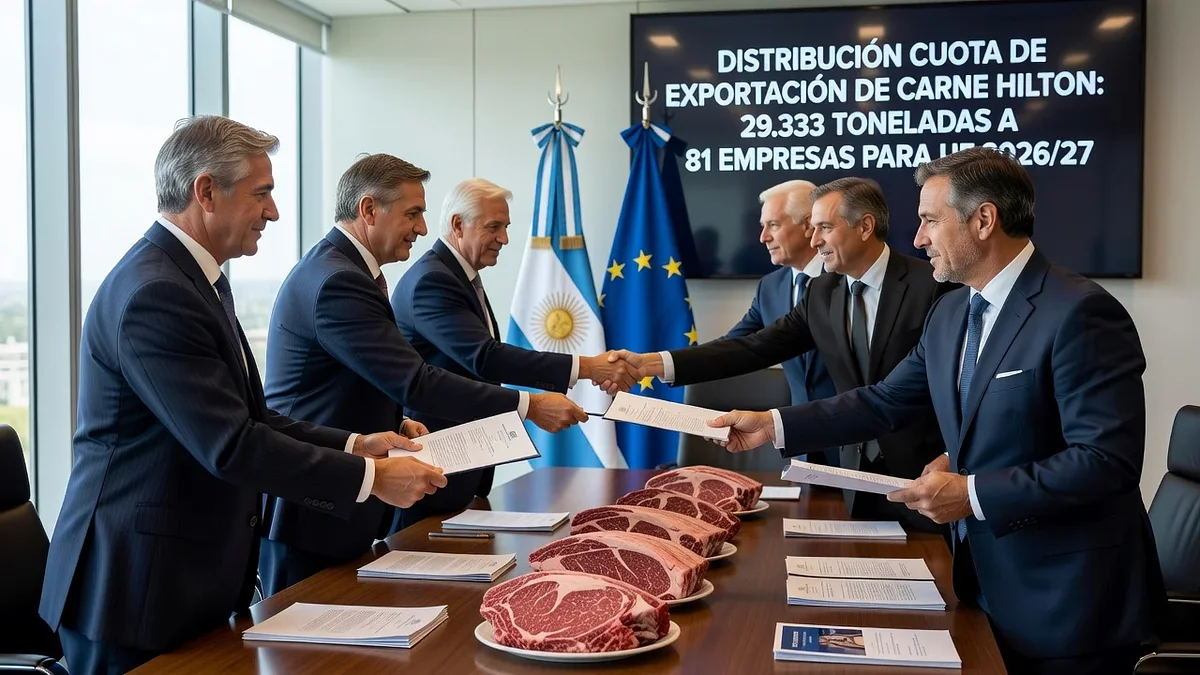
Argentine and US officials shake hands sealing trade deal expanding beef exports to 100,000 tons.
Billede genereret af AI

Argentina signs trade agreement with the United States

Rapporteret af AI Billede genereret af AI

Foreign Minister Pablo Quirno announced a trade agreement between Argentina and the United States that expands the beef export quota to 100,000 tons and removes tariff barriers in key sectors. The deal aims to strengthen bilateral economic ties and could boost exports by up to $1,013 million. The agricultural sector, particularly meat exporters, hailed the pact as a major step forward.

The People's Republic of China announced safeguard measures for beef imports starting January 1, 2026, with country-specific quotas and 55% tariffs on excess volumes. These will affect Argentina, with limits of 511,000 tons in 2026, 521,000 in 2027, and 532,000 in 2028. Experts estimate the initial impact will be limited but could encourage market diversification.

Rapporteret af AI

Building on China's safeguard measures announced January 1, 2026, which impose country-specific beef import quotas through 2028 with 55% tariffs on excess volumes (12.5% within limits), Argentina receives 511,000 tons—exceeding 2025 exports by about 100,000 tons—positioning it and Uruguay as key beneficiaries compared to Brazil and Australia. This eases concerns in Argentina's cattle sector, supporting growth without severe restrictions, though capping major expansions.

Following Mexico's Senate approval of tariffs on Asian imports, Brazil has voiced concerns about potential disruptions to bilateral trade outside the protected automotive sector, urging dialogue to safeguard exports and investments.

Rapporteret af AI

French farmers rallied in Paris with 350 tractors against the Mercosur deal, incomes, and regulations. Prime Minister Sébastien Lecornu responded with an emergency agricultural plan. Meanwhile, South American farmers warmly welcome the treaty.

The Argentine Industrial Union (UIA) issued a statement expressing concern over the manufacturing sector's situation, highlighting the complexity of the current economic model. In the 'QR!' program on Canal E, experts like Guido Bambini and Pablo Caruso analyzed the document, pointing to declines in production, employment, and installed capacity. According to United Nations data, Argentina recorded the second-largest industrial drop worldwide between 2023 and 2025.

Rapporteret af AI

The National Institute of Statistics and Censuses (INDEC) revealed that Argentina obtained a gain of US$ 3.509 million in 2025 thanks to improved terms of trade, driven by a sharper drop in import prices than in exports. Import prices fell 4.5% year-over-year, while export prices declined only 0.6%, raising the index by 4%. This evolution contributed to a trade surplus of US$ 11.286 million.


Dette websted bruger cookies

Vi bruger cookies til analyse for at forbedre vores side. Læs vores privatlivspolitik for mere information.
Afvis