Rubio calls for nuclear control agreement including US, Russia, and China

US Secretary of State Marco Rubio stated that the US and China have achieved 'strategic stability' in their relationship, urging a new nuclear control agreement involving the US, Russia, and China ahead of the upcoming Trump-Xi summit. Rubio made the comments at a Caribbean Community meeting, stressing that such a deal would benefit the world, even as China has publicly declined to join.

US Secretary of State Marco Rubio said on Wednesday at a press conference during a Caribbean Community (CARICOM) meeting in Saint Kitts and Nevis that the US and China now have 'strategic stability' in their long-fractious relationship. The remarks come as a crucial summit between Donald Trump and Xi Jinping approaches.

Rubio stressed that any true arms control agreement in the 21st century must involve China. 'We think ultimately, in the 21st century, for there to be a true arms control agreement, it has to involve China,' he said. 'They have publicly said they are not willing to do it … But we’ll continue to press on it because we think it would be good for the world if we could reach such an agreement.'

The Trump administration has rejected Moscow's offer to extend the New Strategic Arms Reduction Treaty (New Start) for another year, pushing instead for an 'improved' deal that includes China. China has not responded, but Rubio indicated the US will keep pressing the issue.

This position reflects Washington's strategic shift in nuclear arms control to address a multipolar nuclear landscape. Key locations mentioned include Moscow, Washington, Geneva, and Lop Nur.
Articles connexes

South Korean FM Cho Hyun shakes hands with U.S. Secretary of State Marco Rubio in Washington, reaffirming alliance amid tariff tensions.
Image générée par IA

South Korean FM Cho meets Rubio: Talks reaffirm alliance amid tariff standoff

Rapporté par l'IA Image générée par IA

South Korea's Foreign Minister Cho Hyun held talks with U.S. Secretary of State Marco Rubio in Washington on February 3, following anticipation announced earlier this week. Amid President Trump's tariff hike threats over delays in a bilateral trade deal, the diplomats reaffirmed cooperation on nuclear submarines, shipbuilding, North Korea denuclearization, and investments.

Le traité de contrôle des armes nucléaires New START entre les États-Unis et la Russie a expiré début février 2026 sans prolongation. Le président Donald Trump a rejeté une proposition de renouvellement d'un an, critiquant l'accord de l'ère Obama et appelant à un nouveau traité incluant la Chine. Le secrétaire d'État Marco Rubio a souligné la nécessité de prendre en compte la rapide accumulation nucléaire chinoise dans tout cadre futur.

Rapporté par l'IA

US President Donald Trump stated on Thursday via social media that the expiring New Start treaty should not be extended, advocating instead for a new, modernized nuclear agreement involving China and Russia. The treaty expired this week, leaving the world without a legally binding nuclear weapons control pact for the first time in half a century. Experts fear this could end arms control efforts amid heightened global tensions.

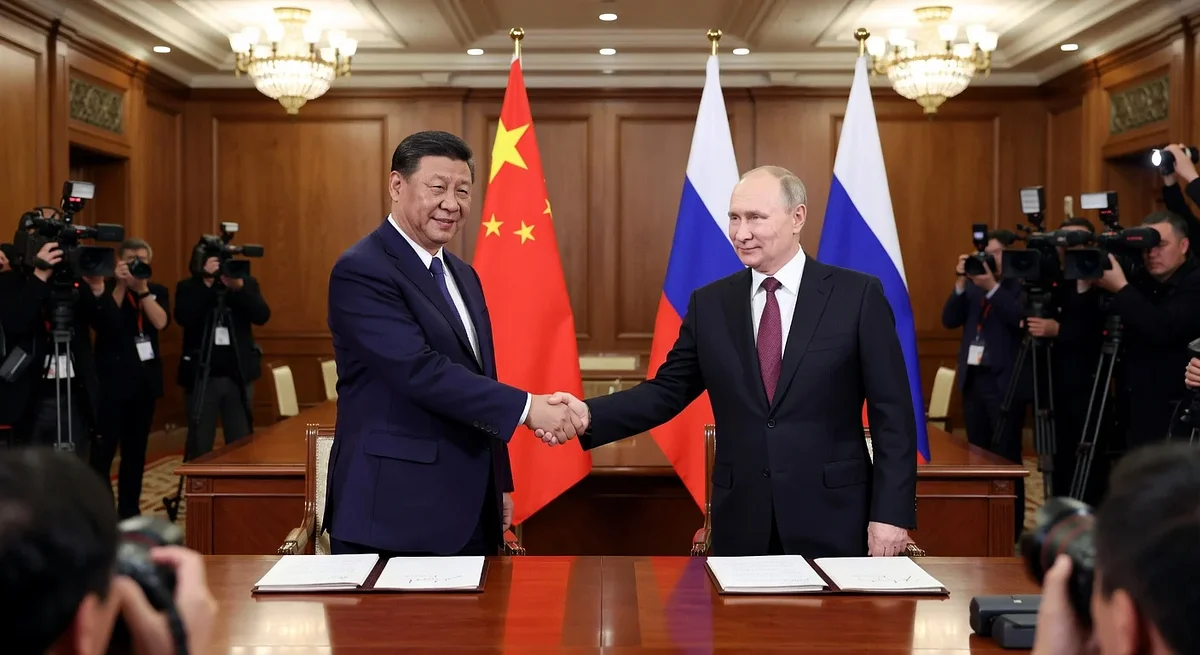
Chinese President Xi Jinping called on China and Russia to boost high-level exchanges and pragmatic cooperation during a virtual meeting with Russian President Vladimir Putin on Wednesday, while urging joint efforts to maintain global strategic stability. Xi extended New Year greetings to Putin and the Russian people, expressing readiness to chart a new blueprint for bilateral ties with him. Putin reciprocated with Spring Festival wishes to Xi and the Chinese people.

Rapporté par l'IA

Russia's Sergey Lavrov and China's Wang Yi met in Beijing on Tuesday to discuss the Iran war, Ukraine and Taiwan. A Chinese readout warned of rising global turmoil in a veiled criticism of Washington and Donald Trump.

In February 2026, the United States at the inaugural Critical Minerals Ministerial sought to rally more than 50 countries and the European Union around a landmark framework to loosen China’s control over the global critical minerals trade. The effort aims to counter Beijing’s dominance in the sector.

Rapporté par l'IA

Le président américain Donald Trump a rejeté une proposition de Vladimir Poutine visant à transférer l'uranium enrichi iranien vers la Russie, selon le média Axios. Cette offre, formulée lors d'un appel téléphonique cette semaine, s'inscrivait dans un accord plus large pour mettre fin au conflit entre les États-Unis, Israël et l'Iran.


Ce site utilise des cookies

Nous utilisons des cookies pour l'analyse afin d'améliorer notre site. Lisez notre politique de confidentialité pour plus d'informations.
Refuser