Brazil uncertain if in-transit beef counts toward China's new quotas

Brazilian officials lack clarity on whether beef shipments en route to China will count against Beijing's new import quotas announced last week. The volume is small relative to 2025 exports, but the industry fears sales disruptions amid the broader safeguard measures affecting major exporters like Argentina and Australia.

Brazil's Ministry of Commerce stated there is no clarity yet on whether beef in transit to China will be included in the quotas. Herlon Brandão, head of the ministry's statistics department, noted these volumes are a "small" share compared to the 1.5 million metric tons exported to China in 2025, when the country absorbed about half of Brazil's record over 3 million tons of total beef exports.

The quotas are part of China's three-year safeguard measures with 55% tariffs on excess volumes. Brazil's allocation is 1.106 million tons in 2026, rising to 1.128 million in 2027 and 1.151 million in 2028.

Brazil's beef sector expressed concerns. Sindifrigo-Mato Grosso stated: "Chinese authorities have made it clear that the volume will be calculated based on actual entries into the country from January 1, 2026, regardless of previously signed contracts, in-transit shipments, or already shipped products."

Under this rule, Brazil could lose about 350,000 tons from its 2026 quota due to shipments in ports, on ships, or stored. In 2025, China accounted for 53% of exports, generating $8.8 billion. The Ministry of Agriculture provided no immediate comment.
Related Articles

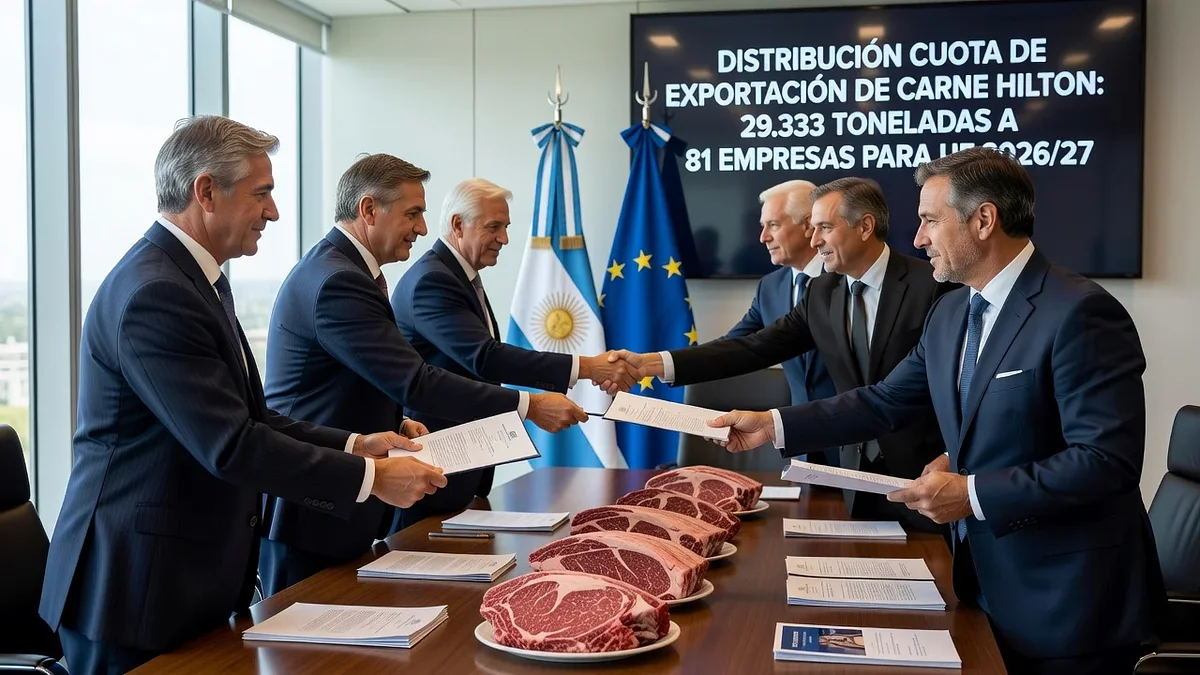
Argentine and US officials shake hands sealing trade deal expanding beef exports to 100,000 tons.
Image generated by AI

Argentina signs trade agreement with the United States

Reported by AI Image generated by AI

Foreign Minister Pablo Quirno announced a trade agreement between Argentina and the United States that expands the beef export quota to 100,000 tons and removes tariff barriers in key sectors. The deal aims to strengthen bilateral economic ties and could boost exports by up to $1,013 million. The agricultural sector, particularly meat exporters, hailed the pact as a major step forward.

Brazil's beef exports to China surged in January 2026, risking exhaustion of the annual quota by September. The government warns that uncontrolled shipments could trigger a domestic price collapse and job losses in the cattle sector. China has set a 55 percent tariff on imports exceeding the quota.

Reported by AI

The People's Republic of China announced safeguard measures for beef imports starting January 1, 2026, with country-specific quotas and 55% tariffs on excess volumes. These will affect Argentina, with limits of 511,000 tons in 2026, 521,000 in 2027, and 532,000 in 2028. Experts estimate the initial impact will be limited but could encourage market diversification.

US President Donald Trump has announced tariffs of up to 25% on countries maintaining commercial ties with Iran, in response to the violent suppression of protests there. The decision puts Brazil on alert, risking exports of meats and other agribusiness products. Experts warn of potential trade tensions and significant economic impacts.

Reported by AI

Brazil's Senate approved the EU-Mercosul free trade agreement on Wednesday (4), completing congressional proceedings and sending the text for presidential sanction. The treaty is expected to take provisional effect in May after notification to the EU. Negotiated since 1999, it links markets with a combined GDP of $22 trillion and will eliminate tariffs on 91% of bilateral trade.

Argentina's agroexport sector commended the progress made in 2025 under President Javier Milei's government, highlighting macroeconomic stabilization, predictability in exchange rates and inflation, and reductions in grain export duties. Gustavo Idígoras, head of CIARA and CEC, foresaw a more stable policy for 2026 benefiting agriculture. These steps produced positive signs amid a year of intense changes.

Reported by AI

China warned Mexico on March 26, 2026, of potential trade reprisals following tariffs imposed in December 2025 on over 1,400 categories of Asian goods, primarily Chinese. The move risks complicating Mexico's USMCA renewal talks with the US. Economy Secretary Marcelo Ebrard dismissed Beijing's complaints, accusing Chinese firms of state-backed dumping.


This website uses cookies

We use cookies for analytics to improve our site. Read our privacy policy for more information.
Decline