Mexico's SRE rejects UN report on enforced disappearances

The UN Committee against Enforced Disappearances requested support measures for Mexico to tackle disappearances that could be deemed crimes against humanity. Mexico's Foreign Relations Secretariat rejected the report as biased and for overlooking government progress. The committee points to over 6,200 bodies in clandestine graves as proof of the crisis.

The UN Committee against Enforced Disappearances (CED) urged the UN on Thursday to consider measures supporting Mexico's government in preventing, investigating, and eradicating enforced disappearances. CED President Juan Albán-Alencastro stated, "International law does not require crimes against humanity to occur on a national scale or be orchestrated from high government levels; what matters is the magnitude, pattern of attacks, and targeting of civilians."

The report notes ongoing discoveries of clandestine graves holding over 6,200 bodies and 76,000 human remains, mostly unidentified. The CED regrets that despite 2021 visits and adopted measures, the situation has not substantially improved, with authorities overwhelmed. Many disappearances link to the war on drugs by criminal groups, though some cases suggest public officials' involvement.

The request went to UN Secretary-General António Guterres for the General Assembly, suggesting technical cooperation, financial aid, and support for searches, forensic analysis, and probes into organized crime ties.

Mexico's Secretariat of Foreign Affairs (SRE) dismissed the report as "biased," noting it acknowledges no federal policy for systematic attacks. The current administration does not tolerate disappearances and has advanced reforms, the SRE said. Mexico welcomes international technical cooperation but not on premises misreflecting its reality.
संबंधित लेख

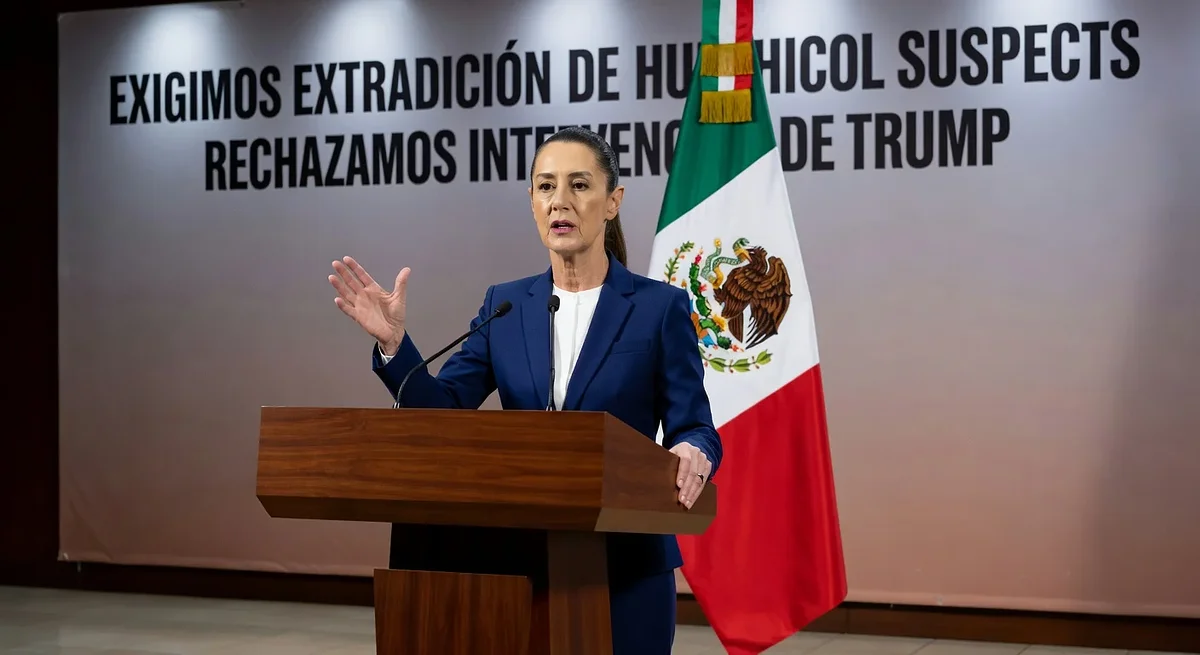
Mexican President Sheinbaum and Interior Secretary Rodríguez announce willingness to collaborate with UN High Commissioner on issue of disappeared persons.
AI द्वारा उत्पन्न छवि

Mexico willing to collaborate with UN high commissioner on disappeared

AI द्वारा रिपोर्ट किया गया AI द्वारा उत्पन्न छवि

President Claudia Sheinbaum and Interior Secretary Rosa Icela Rodríguez expressed Mexico's government willingness to collaborate with UN High Commissioner for Human Rights Volker Türk during his visit next week. Türk will meet with officials, disappeared persons' collectives, and organizations. The announcement comes amid disagreements with a UN Committee against Enforced Disappearance report.

Building on the UN Committee against Enforced Disappearances (CED) report urging global support for Mexico's crisis, the government issued a joint statement from the Foreign Relations (SRE) and Interior (Segob) ministries on Thursday, rejecting it as 'biased' and lacking rigor. Officials highlighted overlooked recent efforts and accused the report of focusing on pre-2018 events.

AI द्वारा रिपोर्ट किया गया

Mexico's National Human Rights Commission (CNDH) rejected on Saturday, April 4, the conclusions of the UN Committee against Forced Disappearances on the situation in Mexico. It accused the international body of a biased reading lacking historical perspective. The CNDH defended the Mexican state's efforts in searching for missing persons.

The government of Claudia Sheinbaum presented a list of extradition requests rejected or stalled by the United States since 2018.

AI द्वारा रिपोर्ट किया गया

Mexico's Security Cabinet revealed that the two presumed CIA agents killed in a Chihuahua accident on April 19 lacked permission for operational activities. No federal authority knew of their involvement in a raid on a drug lab. Governor María Eugenia Campos created a special unit to investigate the events.

Mexico City prosecutors revealed that a drug trafficking group organized the murder of Ximena Guzmán and José Muñoz, aides to Clara Brugada. Authorities have arrested 18 people in the case so far.

AI द्वारा रिपोर्ट किया गया

Omar García Harfuch, Secretary of Security and Citizen Protection, clarified that the heavy security deployment—including National Guard and state forces—at the March 2 funeral of CJNG leader Nemesio Oseguera Cervantes, 'El Mencho,' in Zapopan, Jalisco, was to safeguard citizens after prior disturbances, not to escort the remains. Authorities also uncovered evidence of cartel payments to local police.


यह वेबसाइट कुकीज़ का उपयोग करती है

हम अपनी साइट को बेहतर बनाने के लिए विश्लेषण के लिए कुकीज़ का उपयोग करते हैं। अधिक जानकारी के लिए हमारी गोपनीयता नीति पढ़ें।
अस्वीकार करें