Indian economy projected to grow 7.4% in 2025-26 amid concerns

The National Statistics Office has forecasted a 7.4% growth for the Indian economy in 2025-26, surpassing earlier expectations. While the first half of the year saw 8% expansion, the second half is expected to moderate to 6.8%. Services sector leads the acceleration, though nominal growth raises fiscal worries.

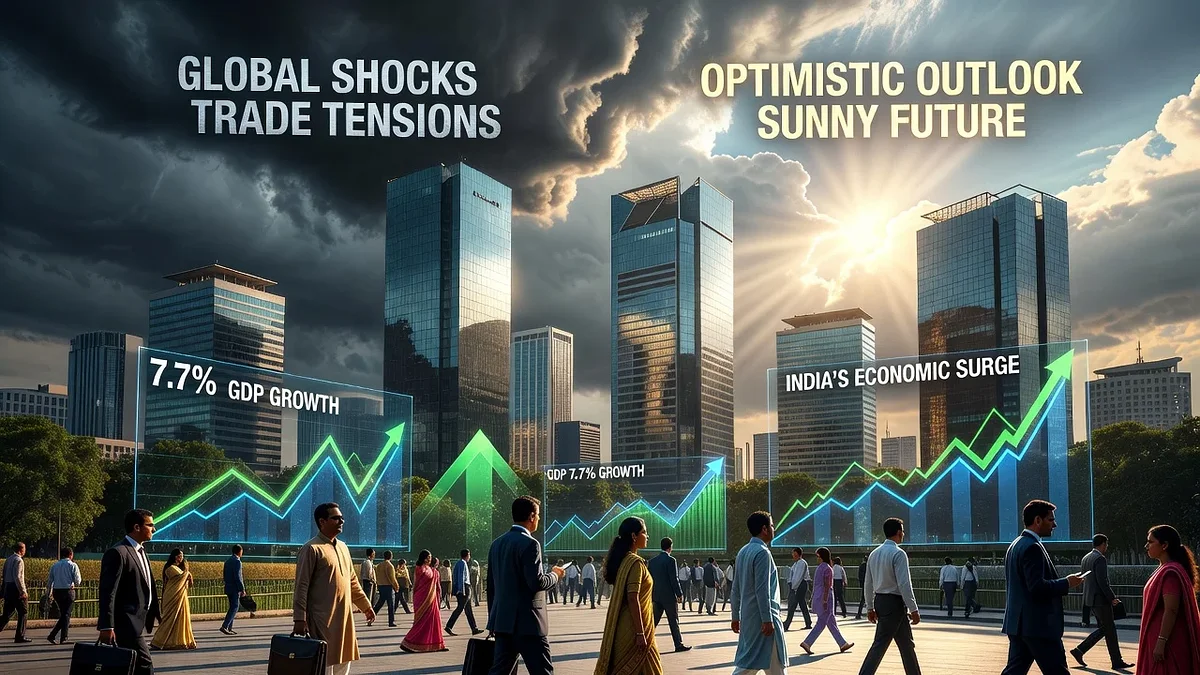
The first advance estimates from the National Statistics Office indicate that India's economy will expand by 7.4% in 2025-26, outpacing projections from analysts and the Reserve Bank of India at the year's start. This follows an 8% growth in the initial six months, with a projected slowdown to 6.8% in the latter half, potentially influenced by reduced government spending and tariffs imposed by US President Donald Trump on merchandise exports.

Disaggregated figures highlight robust performance in the services sector, forecasted to grow at 9.1% this fiscal year, compared to 7.2% in 2024-25. Growth accelerates across sub-sectors including trade, hotels, transport, communication, financial services, real estate, professional services, and public administration. In industry, manufacturing shows improvement, but construction and utilities lag with slower rates. Consumption and investment are both set to advance steadily.

Despite the positive real growth, nominal GDP is expected to rise by only 8%, below the 10.1% assumed in the Union budget and marking the second straight year under 10%. This subdued nominal expansion could strain government debt and deficit management over time.

These estimates draw from data up to November. Upcoming revisions include a new GDP series based on 2022-23 by month's end, incorporating updated methodologies and data sources. A fresh Consumer Price Index with 2024 base follows in February, alongside a revised Index of Industrial Production, aiming to refine accuracy amid past critiques.
관련 기사

Illustration of India's Economic Survey 2025-26 tabling in Parliament, highlighting GDP growth, reforms, manufacturing revival, and PM Modi's approval.
AI에 의해 생성된 이미지

India's economic survey 2025-26 highlights growth and reforms

AI에 의해 보고됨 AI에 의해 생성된 이미지

India's Economic Survey 2025-26, tabled in Parliament on January 30, 2026, projects robust GDP growth amid global uncertainties and recommends key reforms for strategic resilience. It emphasizes manufacturing revival, digital curbs and policy overhauls to bolster economic stability. Prime Minister Narendra Modi praised it as a roadmap for inclusive development.

India recorded an 8.2% GDP growth in the second quarter, driven by strong manufacturing and services sectors. However, the International Monetary Fund has assigned a 'Grade C' to the country's national income accounting practices, highlighting structural weaknesses. This assessment underscores questions about the long-term sustainability of the growth amid uneven sectoral performance.

AI에 의해 보고됨

China's National Bureau of Statistics announced on Monday that the country's gross domestic product grew 5 percent in 2025 to reach 14.02 trillion yuan, meeting the government's target of around 5 percent. Despite a slowdown to a three-year low of 4.5 percent in the fourth quarter, the economy remained steady amid the US trade war.

At the World Economic Forum in Davos, global experts discussed India's robust growth rate, deepening reforms, and key challenges in a panel session. Organized with the India Today Group, participants including Gita Gopinath, Sunil Mittal, Ashwini Vaishnaw, and IKEA's CEO shared insights on India's goal to become a developed nation by 2047. They highlighted digital infrastructure, labor reforms, and obstacles like pollution.

AI에 의해 보고됨

홍콩 재정국장은 2026년 홍콩 경제 전망에 대해 낙관적인 입장을 밝히며, 2025년 성장이 3.2%로 가속화될 것으로 전망, 이전 예측치를 초과할 것이라고 밝혔다. 그는 이 긍정적 전망을 주로 중국 본토와 아시아의 예상 성장 및 금리 인하에 돌렸다.

아시아 기반 경제 감시 기관인 AMRO는 올해 초 시작된 성장 모멘텀에 힘입어 한국 경제가 내년 1.9% 성장할 것으로 전망했다. 이는 이달 한국 정부와의 연례 협의 후 보고서에서 나온 평가다. 2025년 1% 성장 후 가속화될 것으로 보인다.

AI에 의해 보고됨

South Africa's consumer price index averaged 3.2% in 2025, down from 4.4% the previous year, staying within the Reserve Bank's target range. Inflation rose slightly to 3.6% in December, but economists remain optimistic due to factors like fuel price reductions and a stronger rand. The overall trend signals progress in managing price pressures.


이 웹사이트는 쿠키를 사용합니다

사이트를 개선하기 위해 분석을 위한 쿠키를 사용합니다. 자세한 내용은 개인정보 보호 정책을 읽으세요.
거부