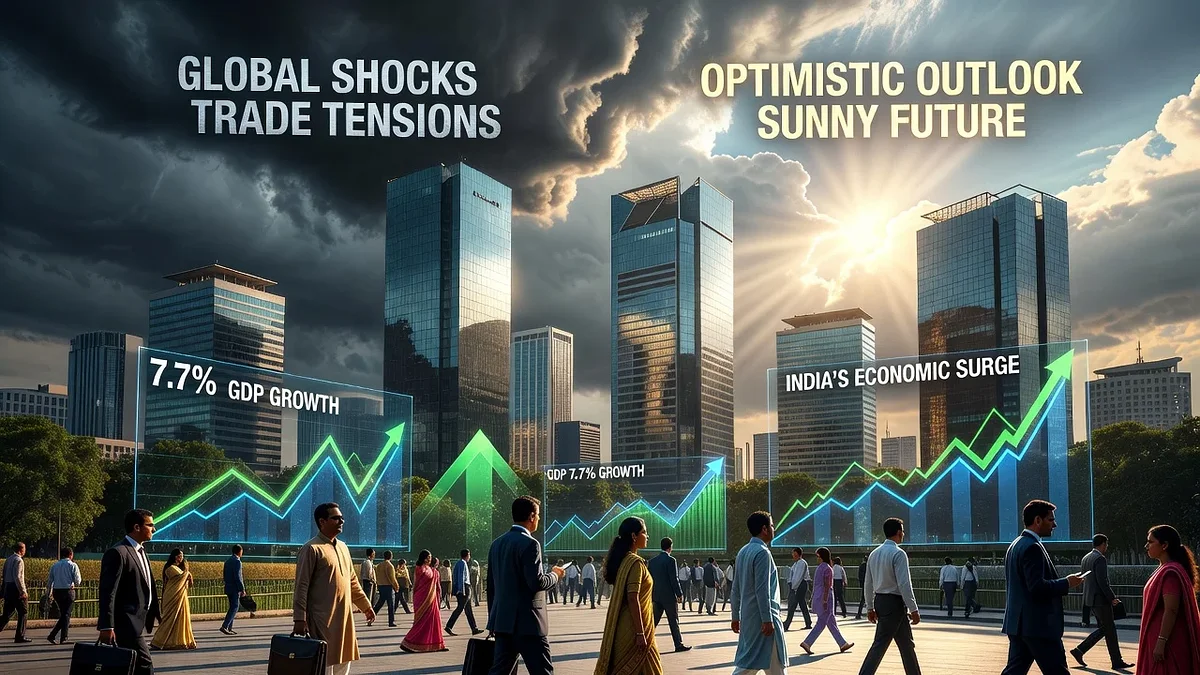
Illustration of India's Economic Survey 2025-26 tabling in Parliament, highlighting GDP growth, reforms, manufacturing revival, and PM Modi's approval.
AI에 의해 생성된 이미지

India's economic survey 2025-26 highlights growth and reforms

AI에 의해 생성된 이미지

India's Economic Survey 2025-26, tabled in Parliament on January 30, 2026, projects robust GDP growth amid global uncertainties and recommends key reforms for strategic resilience. It emphasizes manufacturing revival, digital curbs and policy overhauls to bolster economic stability. Prime Minister Narendra Modi praised it as a roadmap for inclusive development.

The Economic Survey 2025-26, presented by Finance Minister Nirmala Sitharaman in the Lok Sabha, underscores India's economy growing at 7.4% in FY26, outpacing global peers despite trade disruptions from US tariffs under President Trump. It forecasts 6.8-7.2% growth for FY27, raising the potential growth rate to 7% from 6.5% three years ago. Chief Economic Adviser V Anantha Nageswaran highlighted the resurgence of 'economic statecraft', where nations use trade tools like export controls and tariffs for geopolitical aims, citing US restrictions on semiconductors to China and China's curbs on rare earth minerals affecting India's auto sector. The survey warns of vulnerabilities in global value chains amid ultra-nationalism and skepticism toward free trade, urging India to cultivate 'strategic indispensability' through critical roles in supply chains. To boost manufacturing, it proposes a 'National Input Cost Reduction Strategy' via deregulation, noting services alone cannot sustain growth and advocating goods exports for national security stability. It calls for reducing government stakes in listed PSUs to 26% for deeper disinvestment, correcting inverted duty structures and pragmatic Quality Control Orders to enhance competitiveness. On rural employment, the survey praises MGNREGS gains but hails the VB-G RAM G Act 2025 as a 'decisive shift', replacing the 2005 law to align with Viksit Bharat 2047 goals, including infrastructure and climate resilience. Addressing digital addiction, it recommends age verification on social media and offline youth hubs, linking compulsive use to productivity losses in a nation with 970 million internet users. It also suggests re-examining the RTI Act to exempt deliberative processes, preventing it from becoming an 'end in itself'. Prime Minister Modi described the survey as a 'comprehensive picture of India’s Reform Express', focusing on farmers, MSMEs and youth employment. Critics, however, note its arcane language and lack of policy failure analysis, such as underperforming PLIs and internship schemes.
사람들이 말하는 것

Discussions on X about India's Economic Survey 2025-26 are predominantly positive, led by government officials, BJP leaders, and supporters praising the projected 7.4% GDP growth, low inflation at 1.7%, manufacturing revival through PLI schemes, strong forex reserves, and economic resilience amid global uncertainties under PM Modi's leadership. Some neutral summaries from media highlight key data points like job creation and sectoral growth, while a few note challenges such as skilling gaps and global risks.

관련 기사

Finance Minister Nirmala Sitharaman presents the historic ninth Union Budget 2026 in Lok Sabha on February 1, a Sunday.
AI에 의해 생성된 이미지

Nirmala Sitharaman to present ninth budget today

AI에 의해 보고됨 AI에 의해 생성된 이미지

Finance Minister Nirmala Sitharaman will present the Union Budget 2026 in the Lok Sabha on February 1, 2026, a Sunday, marking the first time in independent India's history. This will be her ninth consecutive budget, including one interim. The budget is expected to emphasize economic reforms, fiscal discipline, and addressing global challenges.

The National Statistics Office has forecasted a 7.4% growth for the Indian economy in 2025-26, surpassing earlier expectations. While the first half of the year saw 8% expansion, the second half is expected to moderate to 6.8%. Services sector leads the acceleration, though nominal growth raises fiscal worries.

AI에 의해 보고됨

India recorded an 8.2% GDP growth in the second quarter, driven by strong manufacturing and services sectors. However, the International Monetary Fund has assigned a 'Grade C' to the country's national income accounting practices, highlighting structural weaknesses. This assessment underscores questions about the long-term sustainability of the growth amid uneven sectoral performance.

Finance Minister Enoch Godongwana presented the Medium-Term Budget Policy Statement on 12 November 2025, emphasizing economic growth, structural reforms, and fiscal discipline amid global uncertainties. The statement forecasts 1.2% GDP growth for 2025 and an average of 1.8% through 2028, with debt stabilizing at 77.9% of GDP. Markets reacted positively, with the rand strengthening to 17.05 against the dollar.

AI에 의해 보고됨

국제통화기금(IMF)은 중국의 2026년 성장 전망을 4.5%로 상향 조정했다. 이는 10월 전망치보다 0.3%p 높은 수준으로, 무역 긴장 완화와 지속적인 국내 정책 지원 덕분이다. 중국의 2025년 성장 전망도 0.2%p 상향된 5%로 조정됐다. 이러한 변화는 경기 부양 조치와 투자 목적의 정책 은행 추가 대출을 반영한 것이다.

In 2025, India encountered significant hurdles in its relations with the United States under President Trump, including steep tariffs on its goods and diplomatic setbacks following the Pahalgam terrorist attack. External Affairs Minister S. Jaishankar had expressed optimism earlier in the year about converging interests. However, events unfolded differently, highlighting contrasts in diplomatic strategies with Pakistan.

AI에 의해 보고됨

South Africa's business landscape in 2025 started with optimism amid hopes for lower interest rates and stable governance, but quickly faced challenges from power stability gains to budget disputes and international trade pressures.


이 웹사이트는 쿠키를 사용합니다

사이트를 개선하기 위해 분석을 위한 쿠키를 사용합니다. 자세한 내용은 개인정보 보호 정책을 읽으세요.
거부