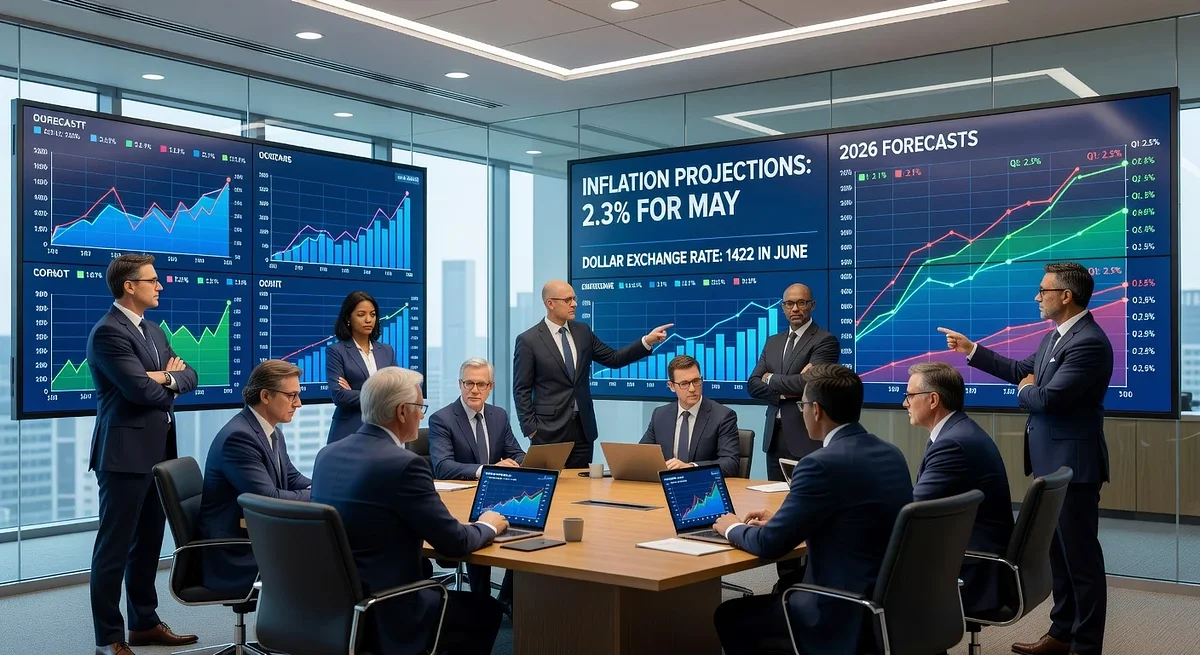
Chilean economists anticipate a negative or zero variation in the Consumer Price Index (IPC) for December, closing 2025 annual inflation around 3.5% or 3.6%. For the first quarter of 2026, they project convergence below 3%, driven by drops in fuels, food, and electricity. Official data will be released on January 8.
Inflation in Chile shows signs of deceleration after four years above 3%. As of November, the IPC accumulates 3.4% annually, and experts expect December to record between 0% and -0.2%, according to projections from economists at various consultancies.
Nathan Pincheira, chief economist at Fynsa, updated his estimate to -0.1% for December, attributed to 'important drop in fuel prices and additional declines in some food prices'. This would close 2025 inflation at 3.6%, converging to 3% in the first quarter of 2026, 'with high probability in January'.
Alejandro Fernández from Gemines agrees with -0.1% and 3.5% annual, highlighting drops in food, beverages, and clothing, despite seasonal components. For the first quarter, he expects figures lower than 2025 due to smaller increases in electricity and education, projecting 3% for all of 2026.
Pavel Castillo from Corpa forecasts -0.1% in December and 3.5% for 2025, with 2.4% in the first quarter of 2026 due to exchange rate effects, and 2.9% annual. Felipe Alarcón from Euroamerica estimates -0.2% and 3.5%, with inflation below 3% from January: 2.7% in twelve months, 2.5% in February, and 2.3% in March.
Valentina Apablaza from Universidad Diego Portales anticipates 0% monthly and 3.6% annual, explaining that recent acceleration is due to 'base comparison effect, and not new inflationary pressures'. She projects convergence to 3% in January or February, with an average of 2.9% in the first quarter, thanks to fuels, exchange rate at $900 per dollar, reductions in seasonal foods, and electricity charge restitutions from January 2026.
The National Institute of Statistics (INE) will release official data on January 8, confirming if these expectations materialize in a year-end with controlled inflation.