China imposes quota on Argentine beef imports

The People's Republic of China announced safeguard measures for beef imports starting January 1, 2026, with country-specific quotas and 55% tariffs on excess volumes. These will affect Argentina, with limits of 511,000 tons in 2026, 521,000 in 2027, and 532,000 in 2028. Experts estimate the initial impact will be limited but could encourage market diversification.

The People's Republic of China will implement safeguard measures on beef imports starting January 1, 2026, lasting three years until December 31, 2028. These include country-specific tariff quotas, with a 55% tariff on volumes exceeding set limits. The affected countries, by volume order, are Brazil, Argentina, Uruguay, New Zealand, Australia, and the United States.

For Argentina, the duty-free limit is 511,000 tons in 2026, 521,000 in 2027, and 532,000 in 2028. According to data from the Instituto de Promoción de la Carne Vacuna Argentina (IPCVA), between January and November 2025, 453,860 tons were exported to China, representing 70% of total shipments, a 12.5% volume drop from 2024 but a 20.2% increase in foreign currency to US$1.723 million.

Fernando Herrera, president of the Asociación de Productores Exportadores Argentinos (APEA), stated that the quotas "are aligned with what we've been exporting in recent years, so it seems it won't affect us too much. Of course, this will impact volume growth, because with the 55% tariff, it might be hard to grow." He added it could be positive for seeking other markets, such as the potential 88,000-ton quota to the United States.

Herrera also highlighted uncertainties regarding quota administration in Argentina and certification for January shipments. Consultant Víctor Tonelli estimated 2025 exports to China at around 500,000 tons, potentially dropping to 400,000 in 2026 due to increased U.S. shipments and lower cattle supply, staying below the limit. "For 2027, I don't think the 'China Quota' will affect us either," Tonelli concluded.

These measures force Argentina to rethink its production model, promoting diversification of export destinations.
Related Articles

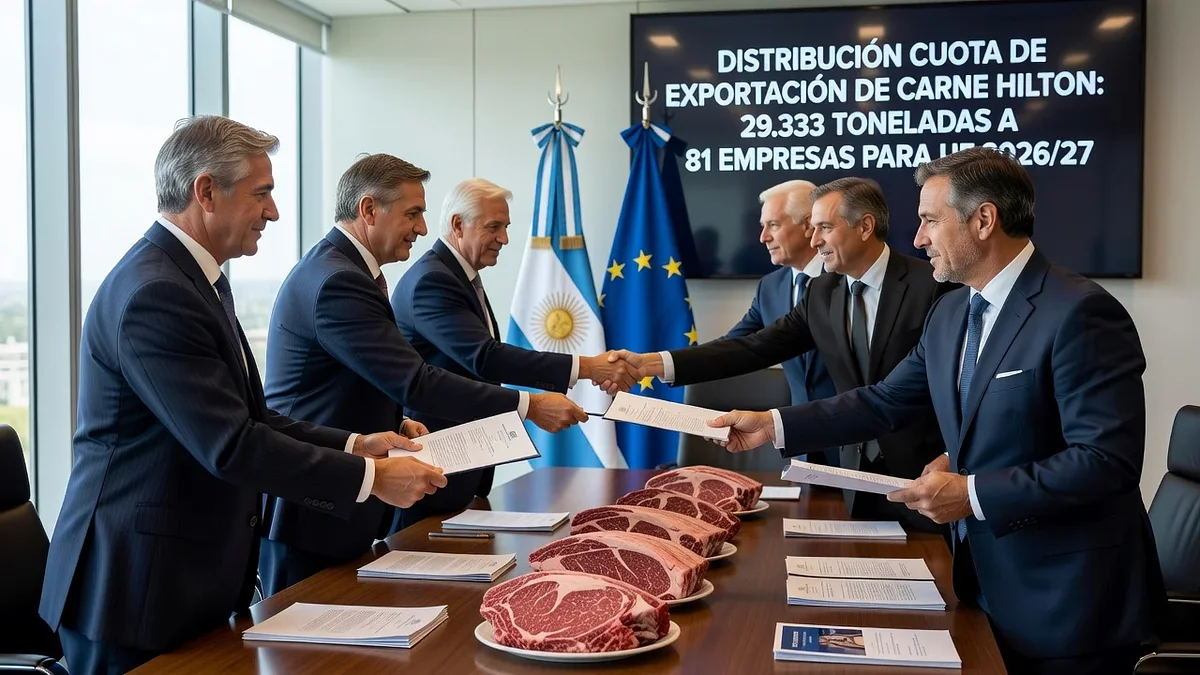
Argentine and US officials shake hands sealing trade deal expanding beef exports to 100,000 tons.
Image generated by AI

Argentina signs trade agreement with the United States

Reported by AI Image generated by AI

Foreign Minister Pablo Quirno announced a trade agreement between Argentina and the United States that expands the beef export quota to 100,000 tons and removes tariff barriers in key sectors. The deal aims to strengthen bilateral economic ties and could boost exports by up to $1,013 million. The agricultural sector, particularly meat exporters, hailed the pact as a major step forward.

Building on China's safeguard measures announced January 1, 2026, which impose country-specific beef import quotas through 2028 with 55% tariffs on excess volumes (12.5% within limits), Argentina receives 511,000 tons—exceeding 2025 exports by about 100,000 tons—positioning it and Uruguay as key beneficiaries compared to Brazil and Australia. This eases concerns in Argentina's cattle sector, supporting growth without severe restrictions, though capping major expansions.

Reported by AI

Brazil's beef exports to China surged in January 2026, risking exhaustion of the annual quota by September. The government warns that uncontrolled shipments could trigger a domestic price collapse and job losses in the cattle sector. China has set a 55 percent tariff on imports exceeding the quota.

The Colombian government has approved a list of products imported from Ecuador that will face a 30% tariff in response to similar measures by that country. The decision aims to restore trade balance within the Andean Community framework. Commerce Minister Diana Marcela Morales Rojas justified the action as a defense of national security.

Reported by AI

Mexico's Senate has approved legislation imposing tariffs of up to 50 per cent on more than 1,400 products from Asian countries, primarily targeting Chinese imports to bolster domestic producers. President Claudia Sheinbaum defended the move, stating it supports the 'Plan Mexico' without harming the national economy. Beijing has criticised the duties as damaging to its interests.

Following the December 2025 decree imposing 5-50% tariffs on non-FTA imports, Mexico's measures particularly target the automotive sector, hiking duties on light vehicles to 50% and parts up to 50%. While aiming to protect national industry and generate over 70 billion pesos in revenue, the policy draws criticism for slowing Chinese EV tech adoption, though brands remain bullish on Mexico's market thanks to local plants.

Reported by AI

US President Donald Trump signed a decree on Friday (20) imposing a 10% tariff on imports from all countries, responding to the Supreme Court's ruling that previous tariffs under the IEEPA law were illegal. The new measure takes effect on February 24 and lasts 150 days, exempting items like beef, oranges, and critical minerals. For Brazil, the global rate improves competitiveness compared to prior reciprocal tariffs of up to 50%.


This website uses cookies

We use cookies for analytics to improve our site. Read our privacy policy for more information.
Decline