China imposes quota on Argentine beef imports

The People's Republic of China announced safeguard measures for beef imports starting January 1, 2026, with country-specific quotas and 55% tariffs on excess volumes. These will affect Argentina, with limits of 511,000 tons in 2026, 521,000 in 2027, and 532,000 in 2028. Experts estimate the initial impact will be limited but could encourage market diversification.

The People's Republic of China will implement safeguard measures on beef imports starting January 1, 2026, lasting three years until December 31, 2028. These include country-specific tariff quotas, with a 55% tariff on volumes exceeding set limits. The affected countries, by volume order, are Brazil, Argentina, Uruguay, New Zealand, Australia, and the United States.

For Argentina, the duty-free limit is 511,000 tons in 2026, 521,000 in 2027, and 532,000 in 2028. According to data from the Instituto de Promoción de la Carne Vacuna Argentina (IPCVA), between January and November 2025, 453,860 tons were exported to China, representing 70% of total shipments, a 12.5% volume drop from 2024 but a 20.2% increase in foreign currency to US$1.723 million.

Fernando Herrera, president of the Asociación de Productores Exportadores Argentinos (APEA), stated that the quotas "are aligned with what we've been exporting in recent years, so it seems it won't affect us too much. Of course, this will impact volume growth, because with the 55% tariff, it might be hard to grow." He added it could be positive for seeking other markets, such as the potential 88,000-ton quota to the United States.

Herrera also highlighted uncertainties regarding quota administration in Argentina and certification for January shipments. Consultant Víctor Tonelli estimated 2025 exports to China at around 500,000 tons, potentially dropping to 400,000 in 2026 due to increased U.S. shipments and lower cattle supply, staying below the limit. "For 2027, I don't think the 'China Quota' will affect us either," Tonelli concluded.

These measures force Argentina to rethink its production model, promoting diversification of export destinations.
相关文章

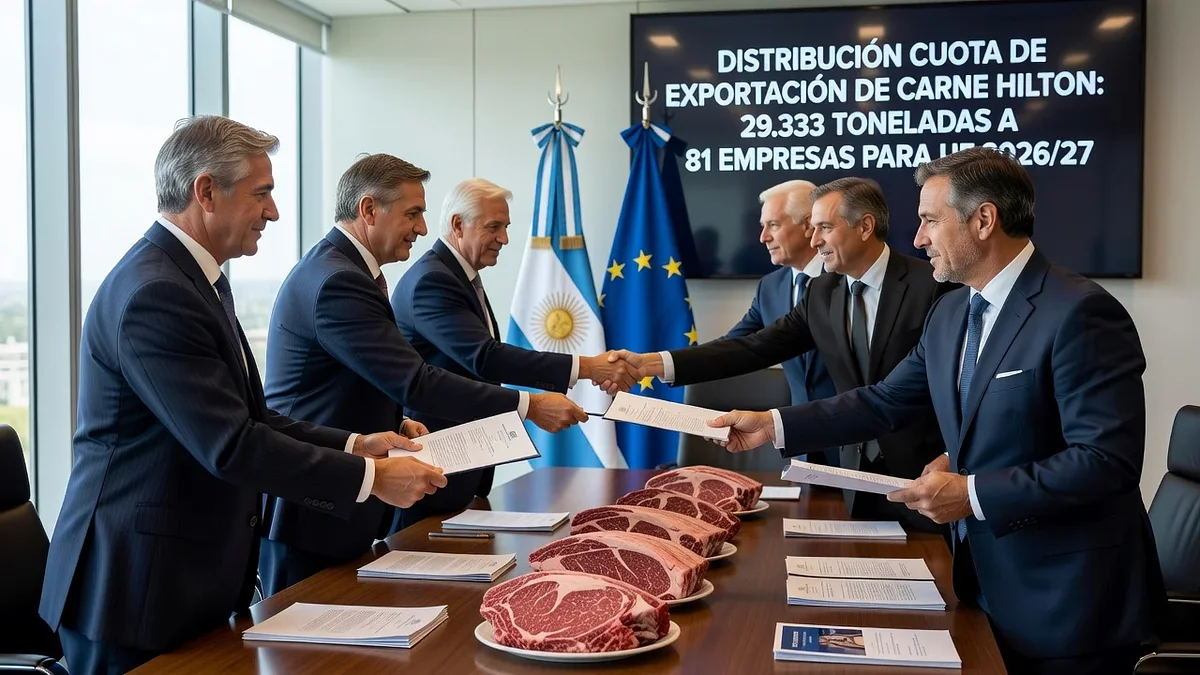
Argentine and US officials shake hands sealing trade deal expanding beef exports to 100,000 tons.
AI 生成的图像

Argentina signs trade agreement with the United States

由 AI 报道 AI 生成的图像

Foreign Minister Pablo Quirno announced a trade agreement between Argentina and the United States that expands the beef export quota to 100,000 tons and removes tariff barriers in key sectors. The deal aims to strengthen bilateral economic ties and could boost exports by up to $1,013 million. The agricultural sector, particularly meat exporters, hailed the pact as a major step forward.

Building on China's safeguard measures announced January 1, 2026, which impose country-specific beef import quotas through 2028 with 55% tariffs on excess volumes (12.5% within limits), Argentina receives 511,000 tons—exceeding 2025 exports by about 100,000 tons—positioning it and Uruguay as key beneficiaries compared to Brazil and Australia. This eases concerns in Argentina's cattle sector, supporting growth without severe restrictions, though capping major expansions.

由 AI 报道

2026年1月巴西对华牛肉出口激增,使年度配额面临提前耗尽的风险,预计9月前达到上限。巴西政府警告,若不控制出口,可能导致国内价格崩盘和畜牧业就业损失。中国对超额进口征收55%的关税。

Following Senate approval of tariffs on over 1,400 Asian products amid USMCA review tensions, Mexico published a decree on December 29, 2025, in the Official Gazette detailing 5% to 50% duties on imports from non-free trade agreement countries like China, effective January 1, 2026. Affecting goods such as clothing, toys, shampoo, and auto parts, the measures aim to protect domestic industry and generate 70 billion pesos in revenue with minimal 0.2% inflation impact.

由 AI 报道

中国商务部周四警告墨西哥,可能对墨西哥对1400多种亚洲商品征收关税采取报复措施,此举可能复杂化墨西哥与美国的贸易谈判。墨西哥经济部长马塞洛·埃布拉德驳斥了这一立场,称中国企业以国家支持低于成本销售。

Brazil's trade deficit with the United States jumped from US$ 283 million in 2024 to US$ 7.5 billion in 2025, multiplying by 26 following tariff measures imposed by President Donald Trump. This marks the 17th consecutive year the goods flow favors Americans, with Brazilian exports dropping 6.6% and imports rising 11%. Brazilian officials attribute part of the impact to tariffs, but also to internal economic factors and reduced demand for oil.

由 AI 报道

The Rosario Grain Exchange projects that grain production in the 2025/26 campaign will reach a record 154.8 million tons, 12% above the previous historical high. However, exports will generate only $36.8 billion due to falling international prices. Corn and wheat will lead this production growth.


此网站使用 cookie

我们使用 cookie 进行分析以改进我们的网站。阅读我们的 隐私政策 以获取更多信息。
拒绝