Permissibility provisions in crypto bill could expand bank activities

A proposed crypto market structure bill includes provisions that could significantly broaden the activities banks are legally allowed to pursue with digital assets, according to experts. While lobbyists debate restrictions on crypto rewards resembling yields, the permissibility section may have a larger impact on banking operations. This comes amid ongoing volatility in cryptocurrency markets.

The crypto market structure bill under discussion in Washington aims to clarify and expand the permissible activities for banks and their holding companies involving digital assets. Published on February 24, 2026, reports highlight that this legislation responds to differing regulatory approaches between the Biden and Trump administrations. Under Biden, regulators required banks to consult prudential overseers before engaging in cryptocurrency activities and adopted a cautious stance to limit risks.

In contrast, the bill's authors intend to codify Trump-era guidelines that have already eased restrictions, allowing banks greater involvement in crypto. David Portilla, co-head of Davis Polk's financial institutions practice, noted that statutory authorization provides durability against regulatory shifts. "What we learned between the change of administrations from Trump one to Biden and then Biden to Trump two is that the regulatory actions are not always durable, and so having the statutory authorization would provide that durability," Portilla said. He added that integrating such activities under federal supervision could enhance financial stability.

However, critics argue the bill's broad definition of "digital asset" might create loopholes. Graham Steele, a fellow at the Roosevelt Institute and former Treasury assistant secretary, warned that banks could reclassify impermissible assets by placing them on the blockchain. "All a bank or [bank holding company] would have to do would be put impermissible equities or assets on the blockchain, and it becomes permissible," Steele said. "This seems to potentially open a giant loophole in both the National Bank Act and Bank Holding Company Act restrictions on permissible activities."

Hilary Allen, a bank law professor at American University, echoed these concerns: "It's absolutely something to be concerned about. It essentially eviscerates the banking laws by saying, basically, if you put anything on the blockchain, it inherently becomes a permissible bank activity."

The debate over yield-like rewards has stalled progress, with banks seeking broad prohibitions on crypto firms offering such incentives, while crypto interests push for allowances like subscription programs for stablecoins. A recent White House meeting between stakeholders yielded no public agreement. Meanwhile, bitcoin's price has dropped about 50% since October, mirroring a parallel decline in the overall crypto market value, underscoring the volatility that earlier regulators sought to contain.
Related Articles

Dramatic illustration depicting stalled CLARITY Act talks in the White House, with President Trump, bank executives rejecting a stablecoin deal, and Coinbase CEO Brian Armstrong amid negotiation impasse.
Image generated by AI

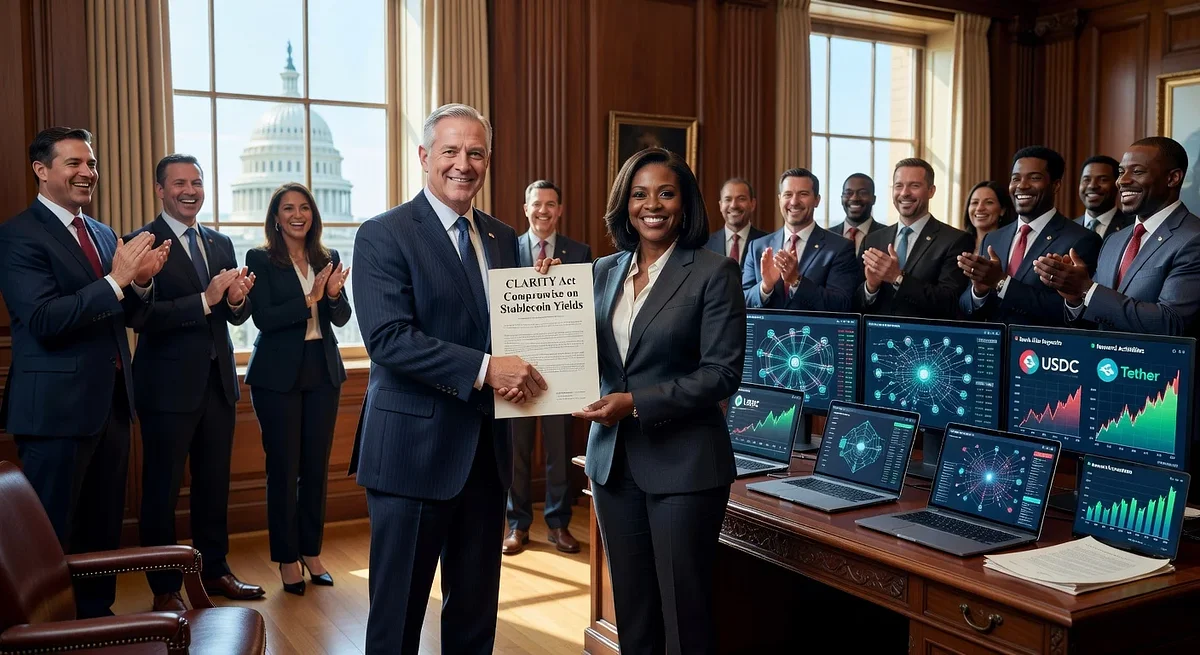
CLARITY Act negotiations stall as banks reject White House stablecoin compromise

Reported by AI Image generated by AI

The US CLARITY Act has hit an impasse after major banks rejected a White House compromise limiting stablecoin yield rewards to peer-to-peer payments. This follows President Trump's recent criticism of banks and builds on stalled talks over incentives that crypto firms say are vital for innovation. Trump met with Coinbase CEO Brian Armstrong amid the deadlock.

Citi analysts report growing momentum for the CLARITY Act, a key U.S. crypto market structure bill, but highlight risks of delays beyond 2026 due to disputes over decentralized finance definitions and stablecoin rewards. The Senate Agriculture Committee has advanced its version, while the Banking Committee grapples with contentious issues. A White House meeting on February 2 aims to address stablecoin concerns.

Reported by AI

A delay in passing U.S. crypto market structure legislation is limiting valuation growth for American-exposed crypto firms, according to Benchmark analyst Mark Palmer. The holdup prolongs regulatory uncertainty amid rising global adoption, though bitcoin and infrastructure plays remain relatively insulated. Palmer still expects the bill to pass, albeit possibly later than anticipated.

The CLARITY Act, aimed at providing regulatory clarity for digital assets, is advancing in Washington with hopes of passage by mid-2026. Negotiations focus on stablecoin yields, drawing involvement from President Trump and industry leaders. The bill could benefit ISO 20022-compliant coins like XRP and Stellar amid ongoing debates between banks and crypto firms.

Reported by AI

President Donald Trump has confirmed that a comprehensive bill on cryptocurrency market structure is nearing passage. This development comes amid ongoing regulatory tensions between key U.S. agencies. The statement signals potential progress in clarifying oversight of digital assets.

At the Ondo Summit in New York City, former House Financial Services Chair Patrick McHenry and White House advisor Patrick Witt expressed optimism about a sweeping crypto market structure bill passing soon. McHenry forecasted the legislation reaching the president's desk by Memorial Day, while Witt highlighted ongoing White House efforts to broker agreements. Disputes over stablecoin yields and ethics rules persist but appear surmountable.

Reported by AI

The cryptocurrency industry is shifting from its lawless origins toward regulated integration with traditional finance, driven by recent U.S. regulatory actions. Moves by agencies like the SEC, DTCC, and OCC are enabling tokenized assets and stablecoins within core market infrastructure. This evolution signals blockchain as an upgrade to existing systems rather than a parallel alternative.

This website uses cookies

We use cookies for analytics to improve our site. Read our privacy policy for more information.
Decline