Argentina Benefits as China Sets Favorable Beef Import Quotas

Building on China's safeguard measures announced January 1, 2026, which impose country-specific beef import quotas through 2028 with 55% tariffs on excess volumes (12.5% within limits), Argentina receives 511,000 tons—exceeding 2025 exports by about 100,000 tons—positioning it and Uruguay as key beneficiaries compared to Brazil and Australia. This eases concerns in Argentina's cattle sector, supporting growth without severe restrictions, though capping major expansions.

Economist Antonela Semadeni of Fundación Agropecuaria para el Desarrollo de Argentina (FADA) noted that China absorbs 60-70% of Argentine beef exports. The quota avoids limiting current sales but curbs significant growth over three years: 'It doesn't limit us today, but it does prevent us from growing,' she told Canal E. The measures address China's domestic industry concerns without evidence of dumping.

Cattle consultant Víctor Tonelli called Argentina and Uruguay 'clear winners,' highlighting the global quota of 2.7 million tons (15% below 2025 levels) but with 2% annual increases and potential flexibilities. He also pointed to opportunities like an extra 80,000-ton U.S. quota at premium prices.

In Argentina, exports are vital for 2026 amid 20-year stagnant cattle stocks and 75% price surges (e.g., asado) outpacing inflation by 40 points. Semadeni cited global shortages driving premiums in the U.S. ($9,000/ton) and Hilton quota ($18,000/ton). Tonelli noted an 8% drop in 2025 export volume but 40% value rise per ton, backed by 21 months of FAO-tracked international price gains.

Effective 2026-2028 with review clauses, the quotas coincide with export liberalization and firm prices aiding recovery—though credit access remains key. Domestic consumption shifts toward pork and poultry have aligned per capita intake at 46-47 kg, nearing beef levels.
Liittyvät artikkelit

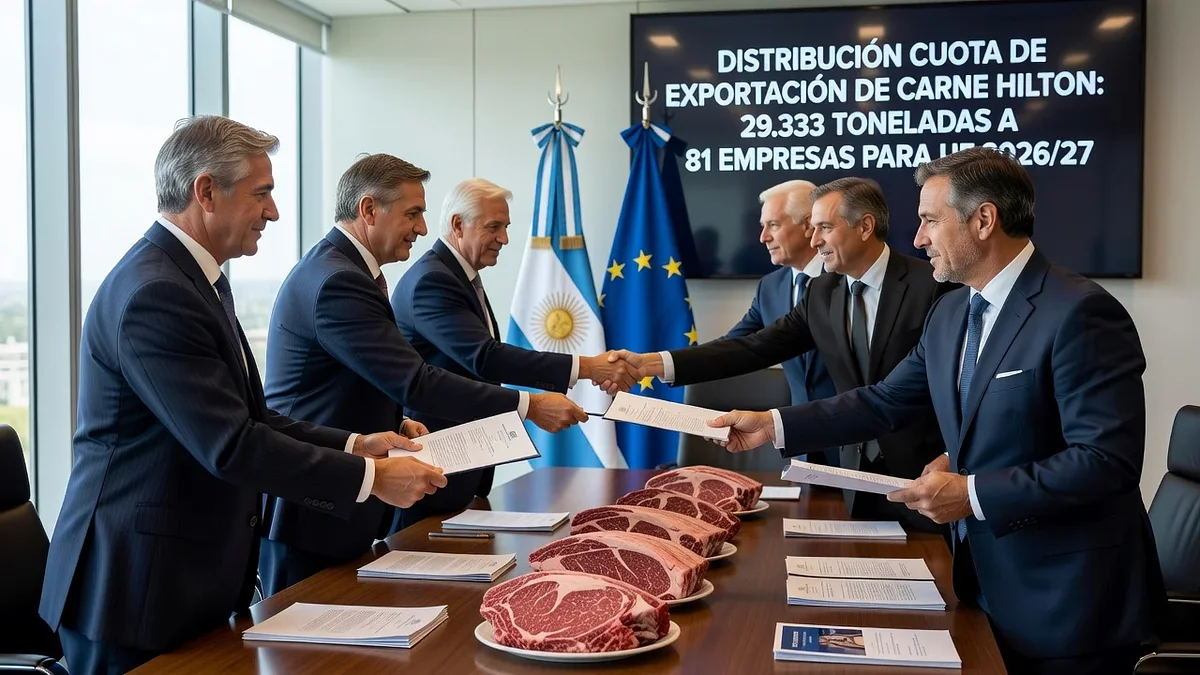
Argentine and US officials shake hands sealing trade deal expanding beef exports to 100,000 tons.
AI:n luoma kuva

Argentina signs trade agreement with the United States

Raportoinut AI AI:n luoma kuva

Foreign Minister Pablo Quirno announced a trade agreement between Argentina and the United States that expands the beef export quota to 100,000 tons and removes tariff barriers in key sectors. The deal aims to strengthen bilateral economic ties and could boost exports by up to $1,013 million. The agricultural sector, particularly meat exporters, hailed the pact as a major step forward.

The People's Republic of China announced safeguard measures for beef imports starting January 1, 2026, with country-specific quotas and 55% tariffs on excess volumes. These will affect Argentina, with limits of 511,000 tons in 2026, 521,000 in 2027, and 532,000 in 2028. Experts estimate the initial impact will be limited but could encourage market diversification.

Raportoinut AI

Brazil's beef exports to China surged in January 2026, risking exhaustion of the annual quota by September. The government warns that uncontrolled shipments could trigger a domestic price collapse and job losses in the cattle sector. China has set a 55 percent tariff on imports exceeding the quota.

Argentina's agroexport sector commended the progress made in 2025 under President Javier Milei's government, highlighting macroeconomic stabilization, predictability in exchange rates and inflation, and reductions in grain export duties. Gustavo Idígoras, head of CIARA and CEC, foresaw a more stable policy for 2026 benefiting agriculture. These steps produced positive signs amid a year of intense changes.

Raportoinut AI

Argentina's domestic consumption ended 2025 with a slight 1.3% uptick during the Christmas holidays, according to Salvador Femenia, CAME's Press Secretary. Yet, formal employment has lost over 240,000 jobs since Milei's government began, with ongoing challenges in reserves and exchange stability. Experts like Roberto Rojas emphasize the need to accumulate dollars to meet 2026 debt maturities.

The European Council approved the free trade agreement between the European Union and Mercosul on Friday (9), with support from 21 of the 27 member states, following negotiations started in 1999. Despite the progress, hurdles remain, including European Parliament approval and potential legal challenges from countries like France. Signing is scheduled for January 17 in Asunción, Paraguay.

Raportoinut AI

Brazil's trade deficit with the United States jumped from US$ 283 million in 2024 to US$ 7.5 billion in 2025, multiplying by 26 following tariff measures imposed by President Donald Trump. This marks the 17th consecutive year the goods flow favors Americans, with Brazilian exports dropping 6.6% and imports rising 11%. Brazilian officials attribute part of the impact to tariffs, but also to internal economic factors and reduced demand for oil.


Tämä verkkosivusto käyttää evästeitä

Käytämme evästeitä analyysiä varten parantaaksemme sivustoamme. Lue tietosuojakäytäntömme tietosuojakäytäntö lisätietoja varten.
Hylkää