Argentina Benefits as China Sets Favorable Beef Import Quotas

Building on China's safeguard measures announced January 1, 2026, which impose country-specific beef import quotas through 2028 with 55% tariffs on excess volumes (12.5% within limits), Argentina receives 511,000 tons—exceeding 2025 exports by about 100,000 tons—positioning it and Uruguay as key beneficiaries compared to Brazil and Australia. This eases concerns in Argentina's cattle sector, supporting growth without severe restrictions, though capping major expansions.

Economist Antonela Semadeni of Fundación Agropecuaria para el Desarrollo de Argentina (FADA) noted that China absorbs 60-70% of Argentine beef exports. The quota avoids limiting current sales but curbs significant growth over three years: 'It doesn't limit us today, but it does prevent us from growing,' she told Canal E. The measures address China's domestic industry concerns without evidence of dumping.

Cattle consultant Víctor Tonelli called Argentina and Uruguay 'clear winners,' highlighting the global quota of 2.7 million tons (15% below 2025 levels) but with 2% annual increases and potential flexibilities. He also pointed to opportunities like an extra 80,000-ton U.S. quota at premium prices.

In Argentina, exports are vital for 2026 amid 20-year stagnant cattle stocks and 75% price surges (e.g., asado) outpacing inflation by 40 points. Semadeni cited global shortages driving premiums in the U.S. ($9,000/ton) and Hilton quota ($18,000/ton). Tonelli noted an 8% drop in 2025 export volume but 40% value rise per ton, backed by 21 months of FAO-tracked international price gains.

Effective 2026-2028 with review clauses, the quotas coincide with export liberalization and firm prices aiding recovery—though credit access remains key. Domestic consumption shifts toward pork and poultry have aligned per capita intake at 46-47 kg, nearing beef levels.
Makala yanayohusiana

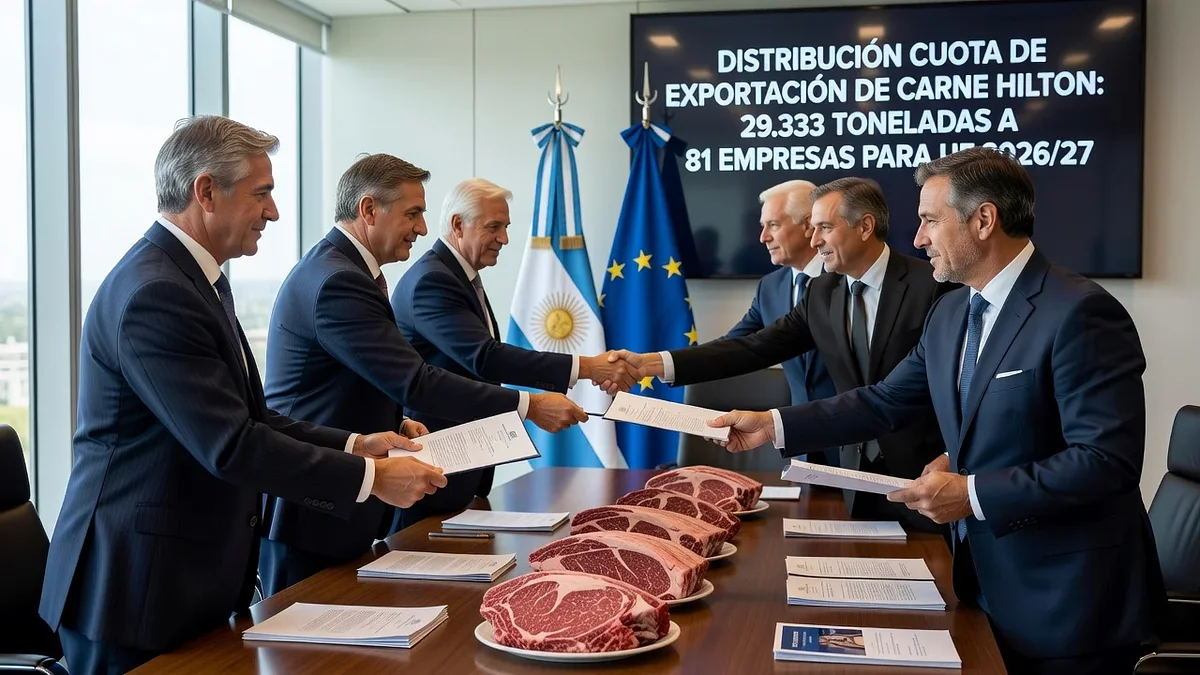
EU diplomats shake hands with Mercosur representatives in front of the European Council, flags waving, amid subtle protests symbolizing trade deal approval despite opposition.
Picha iliyoundwa na AI

European union endorses trade deal with mercosul amid resistances

Imeripotiwa na AI Picha iliyoundwa na AI

The European Council approved the free trade agreement between the European Union and Mercosul on Friday (9), with support from 21 of the 27 member states, following negotiations started in 1999. Despite the progress, hurdles remain, including European Parliament approval and potential legal challenges from countries like France. Signing is scheduled for January 17 in Asunción, Paraguay.

The People's Republic of China announced safeguard measures for beef imports starting January 1, 2026, with country-specific quotas and 55% tariffs on excess volumes. These will affect Argentina, with limits of 511,000 tons in 2026, 521,000 in 2027, and 532,000 in 2028. Experts estimate the initial impact will be limited but could encourage market diversification.

Imeripotiwa na AI

China has announced annual quotas and a 55% tariff on beef imports exceeding limits for South American suppliers like Argentina, Brazil, and Uruguay, but Colombia is exempt due to its small market share.

Brazil's trade deficit with the United States jumped from US$ 283 million in 2024 to US$ 7.5 billion in 2025, multiplying by 26 following tariff measures imposed by President Donald Trump. This marks the 17th consecutive year the goods flow favors Americans, with Brazilian exports dropping 6.6% and imports rising 11%. Brazilian officials attribute part of the impact to tariffs, but also to internal economic factors and reduced demand for oil.

Imeripotiwa na AI

New car sales in Argentina grew nearly 50 percent in 2025, driven by the return of financing and the opening of the automotive market.

EU countries have backed the historic trade deal with Mercosur by qualified majority, paving the way for signing on January 17 in Paraguay. The agreement, negotiated for over 25 years, sparks divisions due to farmers' protests fearing unfair competition. Spain supports the decision, seen as a step toward European strategic autonomy.

Imeripotiwa na AI

Following Mexico's Senate approval of tariffs on Asian imports, Brazil has voiced concerns about potential disruptions to bilateral trade outside the protected automotive sector, urging dialogue to safeguard exports and investments.

Jumatatu, 19. Mwezi wa kwanza 2026, 18:21:41

Argentine industry operates at lowest level since March

Jumamosi, 17. Mwezi wa kwanza 2026, 17:58:21

EU and Mercosur sign free trade agreement

Jumanne, 13. Mwezi wa kwanza 2026, 06:43:59

French farmers protest against Mercosur in Paris

Jumanne, 6. Mwezi wa kwanza 2026, 19:14:57

Brazil uncertain if in-transit beef counts toward China's new quotas

Jumatatu, 5. Mwezi wa kwanza 2026, 02:58:00

Argentine Rural Society Flags Export Risks from China's Beef Quotas

Jumapili, 4. Mwezi wa kwanza 2026, 02:10:51

Argentina heads toward record exports in 2026 despite a more closed world

Ijumaa, 2. Mwezi wa kwanza 2026, 18:20:44

Argentine consumption closes 2025 with modest 1.3% growth

Jumanne, 30. Mwezi wa kumi na mbili 2025, 01:59:34

Mexico publishes decree imposing 5-50% tariffs on non-FTA imports from 2026

Jumamosi, 20. Mwezi wa kumi na mbili 2025, 07:05:53

Agroexport sector praises Milei's 2025 efforts

Jumatano, 17. Mwezi wa kumi na mbili 2025, 13:46:36

EU clinches agricultural safeguards for Mercosur deal amid signing push


Tovuti hii inatumia vidakuzi

Tunatumia vidakuzi kwa uchambuzi ili kuboresha tovuti yetu. Soma sera ya faragha yetu kwa maelezo zaidi.
Kataa