China and Russia discuss boosting transport links as Middle East conflict disrupts shipping

As heightened conflict in the Middle East disrupts global shipping, China and Russia are considering deeper logistics cooperation, including increased use of the Arctic shipping route, to secure a more resilient supply chain. The topics were covered at the inaugural China-Russia Logistics Business Forum.

At the inaugural China-Russia Logistics Business Forum, Dmitry Birichevsky, director of the Department of Economic Cooperation at Russia’s Ministry of Foreign Affairs, called for global instability to be factored into bilateral relations. “We are obliged to take all of this into account,” he said at the forum. “That is precisely why independent payment mechanisms and logistics between our countries, including transit through friendly countries of the Eurasian Economic Union (EAEU) and Commonwealth of Independent States (CIS), are a perfect example of how this can work.” Birichevsky said the Middle East situation revealed how the global economy and logistics networks were vulnerable to the unilateral actions of those fuelling wars. The EAEU is a five-nation customs union consisting of Armenia, Belarus, Kazakhstan, Kyrgyzstan and Russia, while the CIS is a broader regional organisation that includes nine former Soviet republics. Keywords from the forum include logistics, shipping disruption, Arctic Ocean, Arctic shipping route, Arkhangelsk, Moscow, Murmansk, NewNew Shipping, Rosatom, supply chains and transit.
Makala yanayohusiana

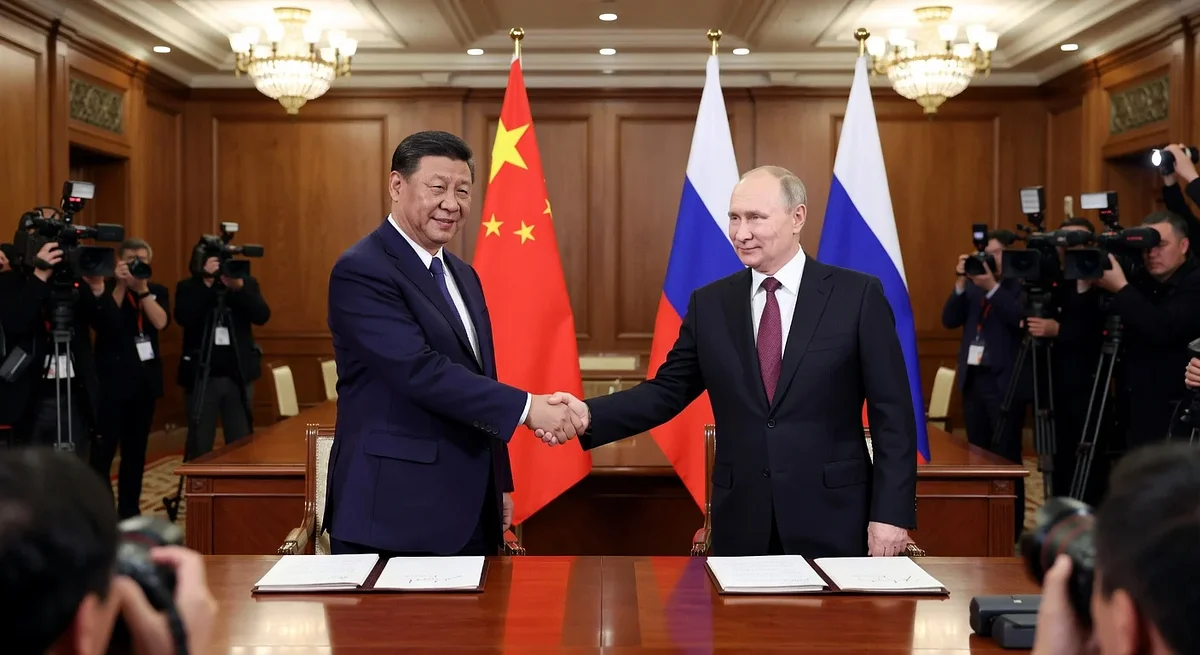
Xi Jinping and Vladimir Putin shaking hands at a Beijing summit, illustrating their deepened strategic partnership.
Picha iliyoundwa na AI

Xi and Putin deepen strategic ties at Beijing summit

Imeripotiwa na AI Picha iliyoundwa na AI

Chinese President Xi Jinping and Russian President Vladimir Putin held talks in Beijing on Wednesday, signing over 40 agreements that mark a historic peak in bilateral relations.

The conflict in the Middle East is disrupting global logistics chains, risking longer delays for packages headed to French consumers. Tensions are particularly affecting air freight through hubs in Dubai, Doha, and Abu Dhabi. Fuel price increases are also being observed.

Imeripotiwa na AI

China's imports of Russian crude spiked in January and February 2026, comprising over one-fifth of its total imported crude by volume. Analysts attribute this to stockpiling amid rising geopolitical risks before the Middle East conflict. However, the Iran war could moderate future Russian shipments to China.

Waziri wa Biashara Lee Kinyanjui amesema kuwa sekta ya mauzo ya nje ya Kenya inakabiliwa na vizuizi vikubwa kutokana na changamoto za usafirishaji kimataifa zinazohusishwa na vita vinavyoendelea Mashariki ya Kati. Muda wa kusafirisha umeongezeka hadi siku 20, na gharama za usafirishaji zimepanda, ikiharibu mauzo ya mazao nyeti kama maua, kahawa na bidhaa za viwanda. Serikali inafanya kazi na washirika ili kupata njia mbadala na kuboresha bandari za Mombasa na Lamu.

Imeripotiwa na AI

Conflict in the Middle East and global turbulence following US-Israeli strikes against Iran have prompted foreign investors to seek certainty in China. Speakers at the China Development Forum highlighted this trend.

US importers have cut orders from Hong Kong firms and shifted to short-term contracts amid a global oil crisis triggered by war in the Middle East. Business leaders warn of eroding profit margins and strained liquidity, urging the government to bolster ties with Central Asia and Asean nations to diversify market risks. Executive Council member Jeffrey Lam Kin-fung said the situation will impact SMEs' cash flow.

Imeripotiwa na AI

The United Arab Emirates and Japan have agreed to promote cooperation aimed at securing a stable crude oil supply amid the closure of the Strait of Hormuz.


Tovuti hii inatumia vidakuzi

Tunatumia vidakuzi kwa uchambuzi ili kuboresha tovuti yetu. Soma sera ya faragha yetu kwa maelezo zaidi.
Kataa