China and Russia discuss boosting transport links as Middle East conflict disrupts shipping

As heightened conflict in the Middle East disrupts global shipping, China and Russia are considering deeper logistics cooperation, including increased use of the Arctic shipping route, to secure a more resilient supply chain. The topics were covered at the inaugural China-Russia Logistics Business Forum.

At the inaugural China-Russia Logistics Business Forum, Dmitry Birichevsky, director of the Department of Economic Cooperation at Russia’s Ministry of Foreign Affairs, called for global instability to be factored into bilateral relations. “We are obliged to take all of this into account,” he said at the forum. “That is precisely why independent payment mechanisms and logistics between our countries, including transit through friendly countries of the Eurasian Economic Union (EAEU) and Commonwealth of Independent States (CIS), are a perfect example of how this can work.” Birichevsky said the Middle East situation revealed how the global economy and logistics networks were vulnerable to the unilateral actions of those fuelling wars. The EAEU is a five-nation customs union consisting of Armenia, Belarus, Kazakhstan, Kyrgyzstan and Russia, while the CIS is a broader regional organisation that includes nine former Soviet republics. Keywords from the forum include logistics, shipping disruption, Arctic Ocean, Arctic shipping route, Arkhangelsk, Moscow, Murmansk, NewNew Shipping, Rosatom, supply chains and transit.
Mga Kaugnay na Artikulo

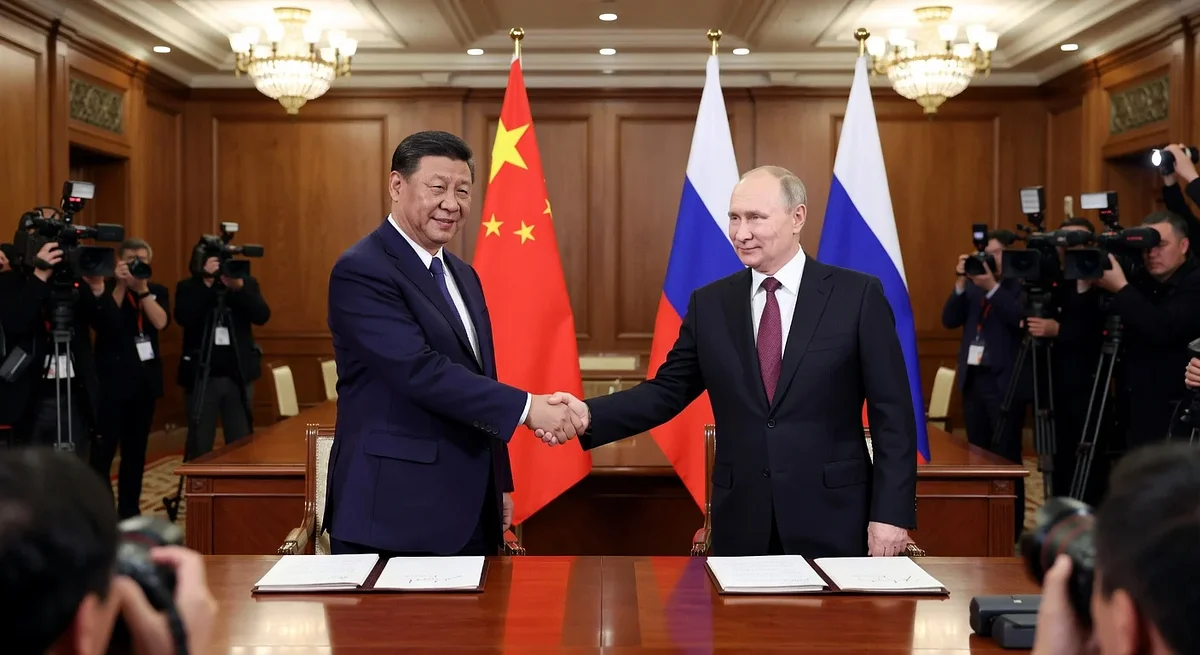
Xi Jinping and Vladimir Putin in virtual meeting, pledging stronger China-Russia ties and global stability.
Larawang ginawa ng AI

Xi calls for stronger China-Russia ties and global stability

Iniulat ng AI Larawang ginawa ng AI

Chinese President Xi Jinping called on China and Russia to boost high-level exchanges and pragmatic cooperation during a virtual meeting with Russian President Vladimir Putin on Wednesday, while urging joint efforts to maintain global strategic stability. Xi extended New Year greetings to Putin and the Russian people, expressing readiness to chart a new blueprint for bilateral ties with him. Putin reciprocated with Spring Festival wishes to Xi and the Chinese people.

The Arctic shipping route is essential to safeguard China’s development over the next decade, a senior Chinese official said at a Beijing forum. He warned that traditional trade lanes through the Strait of Malacca, Red Sea and Suez Canal could be disrupted during a major international crisis. China must prioritize expanding its practical use.

Iniulat ng AI

The conflict in the Middle East is disrupting global logistics chains, risking longer delays for packages headed to French consumers. Tensions are particularly affecting air freight through hubs in Dubai, Doha, and Abu Dhabi. Fuel price increases are also being observed.

Conflict in the Middle East and global turbulence following US-Israeli strikes against Iran have prompted foreign investors to seek certainty in China. Speakers at the China Development Forum highlighted this trend.

Iniulat ng AI

Nagbeto ang China at Russia noong Martes sa isang resolusyon ng United Nations Security Council na nag-e-encourage ng koordinasyon para protektahan ang commercial shipping sa Strait of Hormuz, tinawag nilang biased laban sa Iran. Ang boto ay 11 pabor, dalawang against mula sa China at Russia, at dalawang abstentions. Hinukuman ng US ang mga veto habang nagpapatuloy ang tensyon sa Iran.

Chinese Foreign Minister Wang Yi met Pakistani Deputy Prime Minister and Foreign Minister Ishaq Dar in Beijing on Tuesday to propose a five-point initiative on the Iran situation and Gulf-Middle East stability, calling for an immediate cessation of hostilities and prompt peace talks. The plan stresses protecting civilians, shipping lanes, and the primacy of the UN Charter. It aims to prevent conflict escalation and restore regional peace.

Iniulat ng AI

Logistics costs in Ethiopia account for 25-30% of commodity prices, making them up to 60% higher than in neighboring countries. The lack of direct sea access, infrastructure challenges, and reliance on the Port of Djibouti drive these elevated expenses. The government has introduced incentives for investors and plans to modernize the system to address the issue.


Gumagamit ng cookies ang website na ito

Gumagamit kami ng cookies para sa analytics upang mapabuti ang aming site. Basahin ang aming patakaran sa privacy para sa higit pang impormasyon.
Tanggihan