US and Mexico accelerate actions against criminals and narcoterrorists

The United States and Mexico agreed in Washington to accelerate measures against the fentanyl crisis and transnational criminal networks during the third meeting of the Security Implementation Group. The State Department recognized Mexico's work in capturing criminals like Ryan Wedding. Both nations seek concrete results to protect border communities.

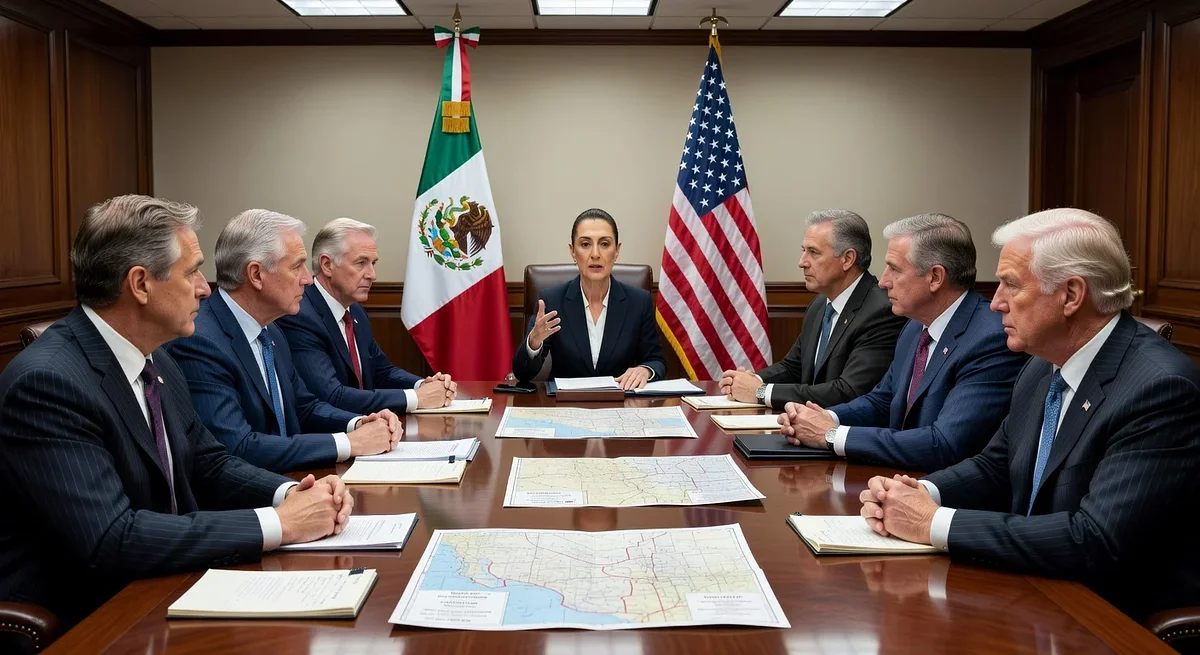
The third meeting of the Security Implementation Group between Mexico and the United States took place this Friday in Washington, under the Border Security and Law Enforcement Cooperation Program. During the encounter, delegations from both countries agreed to accelerate actions to combat the fentanyl crisis and dismantle transnational criminal and narcoterrorist networks.

State Department spokesperson Tommy Pigott stressed that the United States and Mexico are pursuing concrete results to safeguard their communities on both sides of the border. The importance of joint efforts yielding progress against impunity was highlighted.

US authorities thanked the Mexican government for the capture and handover of high-impact criminals, including former Olympic athlete Ryan Wedding, who is on the FBI's Ten Most Wanted list. The meeting also spotlighted advances in customs information exchange, analysis of global threats from unmanned systems, and judicial cooperation.

The Mexican delegation included Roberto Velasco, Undersecretary for North America at the SRE; Jesús Antonio Lozada, Undersecretary of Intelligence and Police Investigation at the SSPC; Esteban Moctezuma, Mexico's Ambassador to the United States; and other security and defense officials. On the US side, participants included Katherine Dueholm, Principal Deputy Assistant Secretary for Western Hemisphere Affairs at the State Department; Simon Bland, Undersecretary for International Affairs at the Department of Homeland Security; and representatives from the Department of Justice and others.

These agreements aim to strengthen bilateral collaboration on security matters, acknowledging mutual advances in the fight against organized crime.
Verwandte Artikel

Mexican President Claudia Sheinbaum demands mutual respect during a press conference on US-Mexico security cooperation.
Bild generiert von KI

Sheinbaum fordert gegenseitigen Respekt in der Sicherheitskooperation mit den USA

Von KI berichtet Bild generiert von KI

Präsidentin Claudia Sheinbaum hat Fortschritte in der bilateralen Sicherheitskooperation mit den Vereinigten Staaten verteidigt, starke Ergebnisse hervorgehoben und gegenseitigen Respekt sowie geteilte Verantwortung gefordert. Dies als Reaktion auf Kritik des US-Außenministeriums, das konkrete Ergebnisse gegen Drogenhandel verlangt. Zudem einigten sich der mexikanische Außenminister und sein Pendant auf Treffen zur Stärkung gemeinsamer Maßnahmen.

A group of 37 alleged cartel members has been transferred from Mexico to the United States to face charges for crimes including drug trafficking and human smuggling. The operation, the largest of its kind, highlights growing cooperation between the two nations amid US pressure on Mexican cartels. Attorney General Pam Bondi described it as a key step in dismantling these criminal networks.

Von KI berichtet

US-Außenminister Marco Rubio lobte die Sicherheitskooperation Mexikos unter Präsidentin Claudia Sheinbaum und stellte fest, dass die mexikanische Regierung in dieser Hinsicht mehr als je zuvor tut. Rubio stellte diese Zusammenarbeit der mangelnden Kooperation Venezuelas gegenüber, das er beschuldigte, sich mit kriminellen Gruppen zu verbünden. Die Aussage fiel bei einer Pressekonferenz zu Grenzsicherheit und Anti-Drogenhandelsplänen unter der Trump-Regierung.

Präsident Donald Trump stellte auf einem Gipfel in Miami den „Schild Amerikas“ vor und bildete eine Militärkoalition mit konservativen lateinamerikanischen Führern, um mit US-Militärmacht gegen Drogenkartelle vorzugehen. Mexiko und Kolumbien wurden ausgeschlossen, was Bedenken hinsichtlich der regionalen Souveränität aufwirft. Präsidentin Claudia Sheinbaum lehnte jede ausländische Militärintervention auf mexikanischem Territorium ab.

Von KI berichtet

Die mexikanische Bundesregierung hat eine umfassende Strategie zur Bekämpfung von Piraterie, Schmuggel und illegalem Handel mit Null-Toleranz-Ansatz gestartet. Unter der Leitung des Wirtschaftsministeriums soll die Initiative die nationale Industrie schützen und die formelle Wirtschaft stärken. Die Ankündigung erfolgte bei einem Forum, das mit dem Council of the Americas gemeinsam organisiert wurde.

Mexican special forces killed Nemesio “El Mencho” Oseguera Cervantes, leader of the Jalisco New Generation Cartel, during a military operation in Tapalpa, Jalisco, on Sunday, with complementary information provided by the United States. The operation triggered violent responses from cartel members, including roadblocks and fires in several states, prompting the U.S. State Department to urge Americans in affected areas to shelter in place. Tourism hubs like Puerto Vallarta and Guadalajara have seen disruptions to flights and transportation.

Von KI berichtet

Mexican special forces, with U.S. intelligence assistance, killed Nemesio Oseguera Cervantes, known as El Mencho, leader of the Jalisco New Generation Cartel (CJNG), in a raid in Tapalpa, Jalisco. The operation has triggered widespread violence across Mexico, including in tourist areas like Puerto Vallarta and Guadalajara, stranding thousands of tourists. The U.S. State Department maintains a Level 4 travel advisory for the bordering state of Tamaulipas due to ongoing dangers.


Diese Website verwendet Cookies

Wir verwenden Cookies für Analysen, um unsere Website zu verbessern. Lesen Sie unsere Datenschutzrichtlinie für weitere Informationen.
Ablehnen