Federal judge blocks Nexstar's Tegna acquisition in antitrust case

A federal judge in Sacramento temporarily halted Nexstar Media Group's operation of Tegna stations following the company's $6.2 billion acquisition, approved by regulators last month. The move came amid antitrust lawsuits from eight states and DirecTV, alleging the deal violates competition laws. Chief Judge Troy Nunley heard arguments last week and plans to rule soon.

Nexstar completed its purchase of rival Tegna on the same mid-March day that the Federal Communications Commission and Justice Department approved the deal, granting a waiver to 2004 ownership limits. The transaction gives Nexstar control of 265 local TV stations reaching 80% of U.S. households across 44 states and Washington, D.C. Nexstar CEO Perry Sook thanked President Trump, FCC Chair Brendan Carr and Justice Department officials for the approvals, speaking from newly acquired WFAA studios in Dallas. Tegna CEO Mike Steib received $22.6 million upon closing, per federal securities filings. Sook highlighted the approvals as recognizing changes in the media landscape. Tegna stations briefly displayed Nexstar logos at newscast ends, but the judge's order required their removal. A coalition of Democratic attorneys general from eight states, along with DirecTV, filed suits claiming the merger harms competition by boosting Nexstar's negotiating power with providers. In court last Tuesday, California's Laura Antonini argued it contradicts antitrust precedent, while Nexstar attorney Alex Okuliar countered that owning more stations does not increase leverage, noting the company holds just 15% of U.S. local stations. Colorado Attorney General Phil Weiser emphasized the need for rival local news sources. Judge Nunley, an Obama appointee, called Nexstar's rush to close 'questionable judgment' and appeared open to a longer pause. Nexstar anticipates $300 million in annual synergies, including consolidated programming in markets like Atlanta and Denver, though past acquisitions led to layoffs. Tegna journalists fear mass cuts in overlapping markets and shifts to NewsNation content.
Relaterte artikler

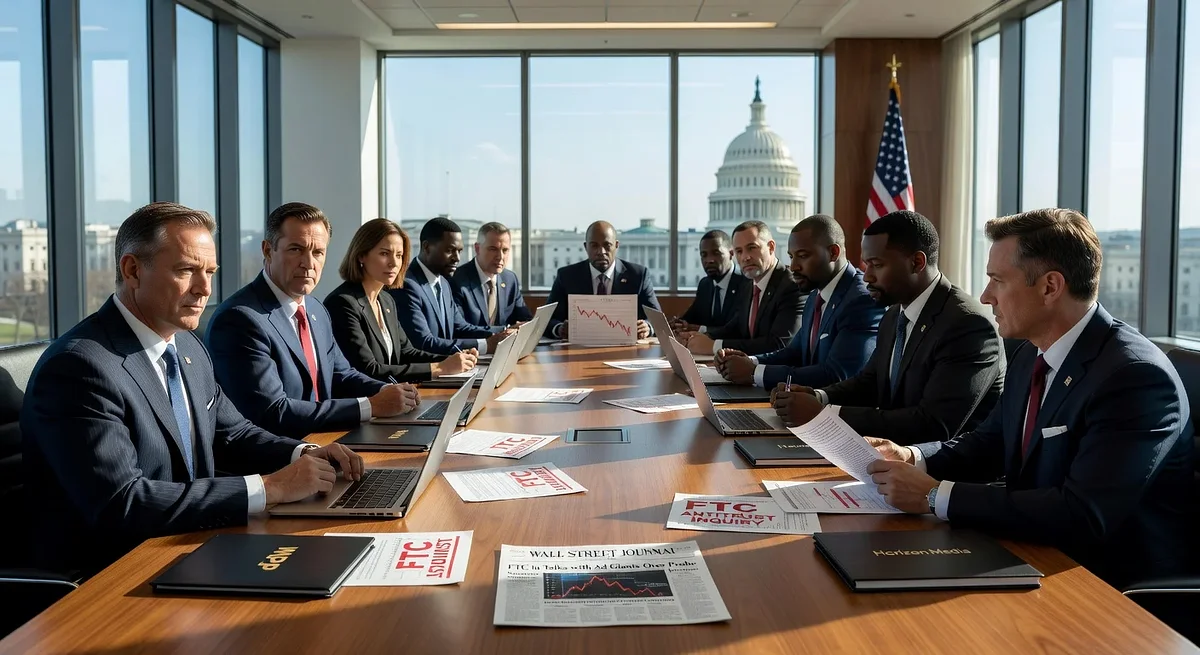
News illustration depicting FTC officials in settlement talks with major ad agency executives amid antitrust probe on ad placements steered from X platform.
Bilde generert av AI

Report: FTC in talks with major ad agencies amid probe into alleged coordination over ad placement decisions

Rapportert av AI Bilde generert av AI Faktasjekket

The Federal Trade Commission is in discussions with several of the world’s largest advertising agencies—including WPP, Publicis Groupe, Dentsu, Havas and Horizon Media—about a possible settlement tied to an antitrust inquiry into whether ad dollars were steered away from certain online platforms, including Elon Musk’s X, for political or ideological reasons, according to The Wall Street Journal as summarized by The Daily Wire.

A US District Judge has dismissed with prejudice X's antitrust lawsuit claiming advertisers colluded to boycott the platform. Judge Jane Boyle ruled that X failed to show consumer harm required for an antitrust claim. The decision comes after advertisers pulled ads citing concerns over content moderation on X.

Rapportert av AI

The U.S. Justice Department has launched an investigation into the National Football League's broadcast and streaming rights practices, probing potential anticompetitive effects that harm consumer affordability and provider competition. The inquiry, amid fan and lawmaker complaints over rising subscription costs for exclusive games, scrutinizes the league's shift to digital platforms while leveraging its antitrust exemptions.

In the ongoing U.S. antitrust trial against Live Nation and Ticketmaster, a group of senators led by Amy Klobuchar and Elizabeth Warren has asked Judge Arun Subramanian to closely examine the company's recent settlement with the Department of Justice. They claim the deal was influenced by political pressure rather than public interest, as the trial—continued by over 30 states after the DOJ deal—nears a verdict.

Rapportert av AI

US Supreme Court justices on Monday expressed doubt about AT&T and Verizon's argument that the Federal Communications Commission's fine procedures violate their right to a jury trial. The carriers, fined $104 million for sharing users' location data without consent, paid the penalties before challenging them. Justices and FCC lawyers agreed the fines are nonbinding without court enforcement.

Dette nettstedet bruker informasjonskapsler

Vi bruker informasjonskapsler for analyse for å forbedre nettstedet vårt. Les vår personvernerklæring for mer informasjon.
Avvis