Main issues in Ethiopian voter registration

Participating in Ethiopian elections requires prior voter registration as a prerequisite. Under Proclamation No. 1162/2011, eligible individuals are Ethiopian citizens aged 18 or older who have resided in the electoral district for at least six months. However, those with mental illnesses impairing judgment, under court-ordered punishments, or legally deprived of voting rights cannot register.

The National Electoral Board of Ethiopia conducts voter registration only within the designated time frame. Registration occurs at polling stations in the voter's kebele of residence, though mobile centers can be established in remote areas if needed. Individuals register only once per polling station.

Required documents prove residency, such as a kebele identification, passport, or alternatives like a birth certificate, residence attestation, or refugee card. Without documents, registration is possible through witnesses or public guarantors confirming residency. Those unable to register personally may do so via representatives.

Registrations are processed daily, verified by registrars and public witnesses. Once completed, the voter list is posted for public viewing for 10 consecutive days. Appeals against inclusions or exclusions go to the polling station's appeal committee, with decisions governed by law. Unregistered voters cannot participate on election day.
Artigos relacionados

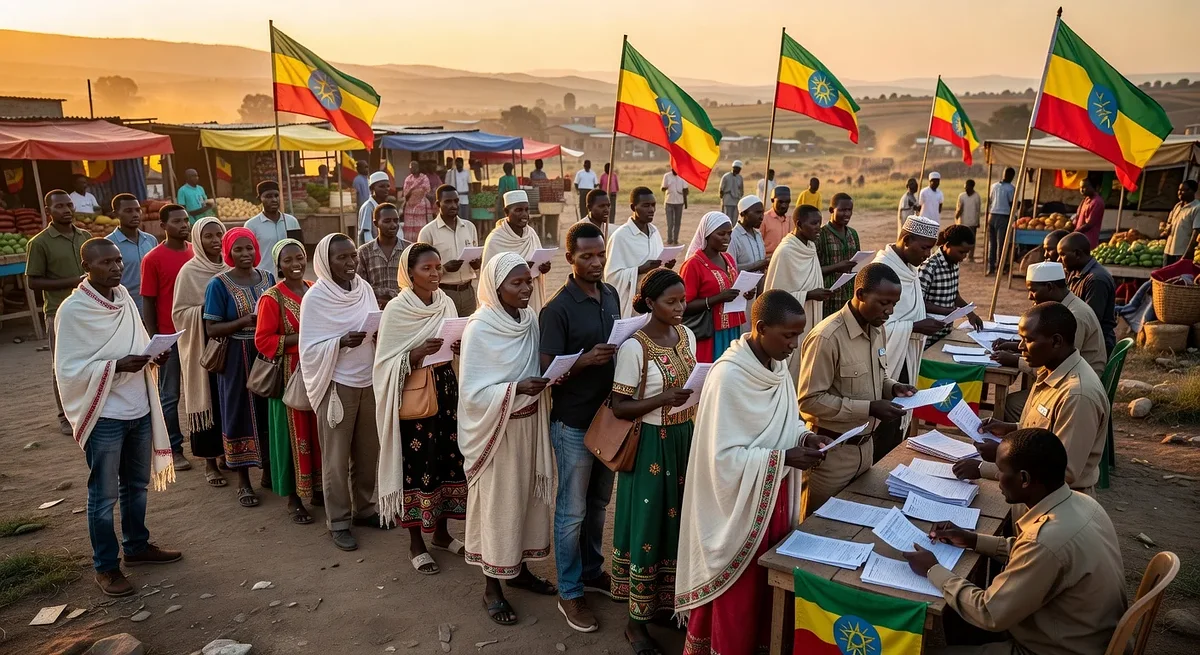
Ethiopian voters registering for the seventh general election at busy centers in Wolkite, Tepi and Harar.
Imagem gerada por IA

Ethiopia registers over 54 million voters for seventh general election

Reportado por IA Imagem gerada por IA

Ethiopia's National Election Board announced that more than 54 million voters have registered for the seventh general election. Residents in Wolkite, Tepi, and Harar cities stated they are ready to cast ballots on May 24. IGAD confirmed ongoing support to ensure the vote is free and credible.

The National Election Board of Ethiopia (NEBE) has issued a stern warning that it may cancel elections in specific constituencies due to coercion in voter registration for the seventh general election. The board highlighted violations of electoral laws, including unauthorized door-to-door campaigns and threats linked to services. It directed authorities to halt such practices immediately.

Reportado por IA

Ethiopia's National Electoral Board reports that 28,366,310 voters have registered for the 7th general election as of Megabit 19, 2018 EC. Registration began on Yekatit 28 through digital and manual channels. Among registrants, 13,047,743 are women and 15,317,057 are men.

The Independent Electoral and Boundaries Commission (IEBC) has announced the Enhanced Continuous Voter Registration (ECVR) starting Monday, March 30, 2026, for 30 days until April 28. Registration will occur daily at Huduma Centres, IEBC offices and other locations nationwide. The drive targets 2.5 million new voters.

Reportado por IA

Ethiopia's seventh general election took place on June 1, 2026. Observers praised the peaceful process but urged reductions in voters per polling station.

Ethiopia's National Election Board has received 47 formal complaints following last week's national elections. Of these, 31 came from political parties and 16 from independent candidates.

Reportado por IA

Kenya's Independent Electoral and Boundaries Commission (IEBC) is considering major policy changes to allow prisoners to vote in all five leadership positions except the presidency. This would enable them to select governors, senators, MPs and others for the first time. The move draws on constitutional rights and past court rulings.

Este site usa cookies

Usamos cookies para análise para melhorar nosso site. Leia nossa política de privacidade para mais informações.
Recusar