West Asia conflict poses risks to India's projected GDP growth

India's economy could face challenges from the West Asia conflict, which may impact oil prices and overall growth. According to Crisil Intelligence, real GDP growth is expected to reach 7.1 percent in FY27, driven by consumer spending and investment. Exports are anticipated to increase, while retail inflation might climb to 4.3 percent.

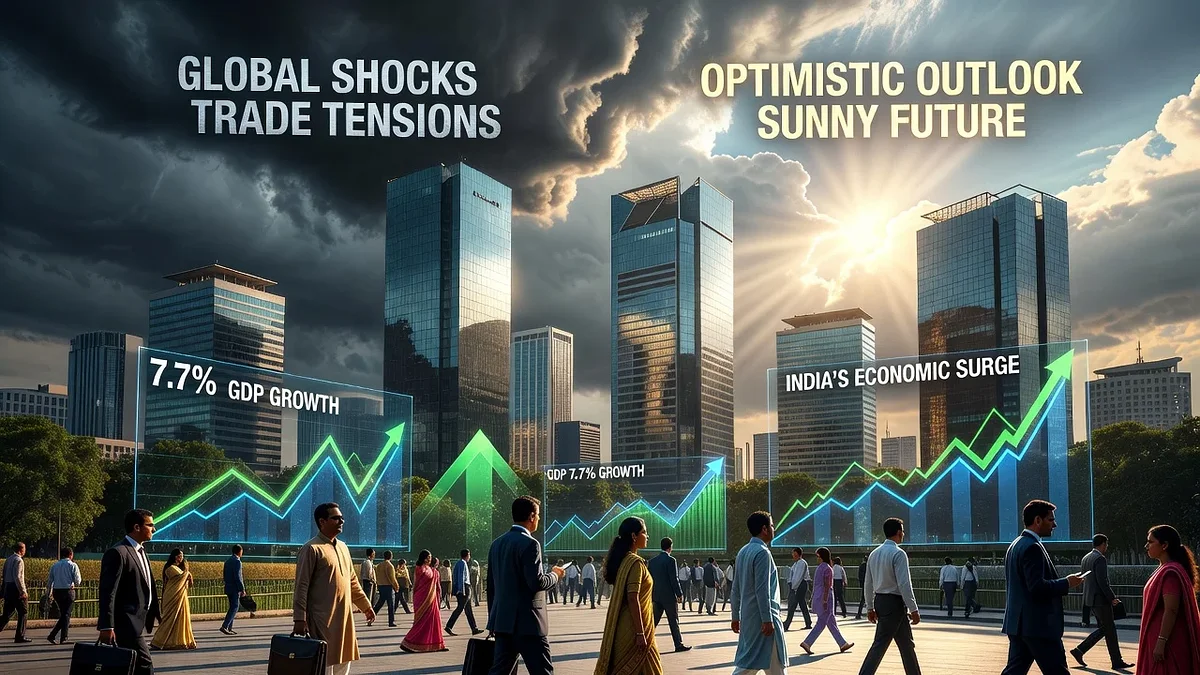
The ongoing West Asia conflict presents a downside risk to India's economic outlook, primarily through its potential effects on crude oil prices. Crisil Intelligence, a leading ratings and research firm, forecasts India's real GDP growth at 7.1 percent for the fiscal year 2027 (FY27). This projection assumes steady support from domestic consumer spending and investment activities.

Exports are expected to contribute positively to this growth trajectory. However, the conflict introduces uncertainties that could disrupt these trends. Retail inflation is projected to rise to 4.3 percent, reflecting pressures possibly linked to higher oil costs.

In response to these dynamics, the Reserve Bank of India (RBI) is likely to hold its interest rates steady, aiming to balance growth and inflationary pressures. The report highlights the importance of monitoring geopolitical developments in West Asia, including tensions involving Iran, as keywords such as 'west asia conflict' and 'iran war' underscore the regional focus.

This assessment comes amid broader economic indicators, emphasizing resilience in consumer and investment sectors despite external risks. Crisil's analysis provides a measured view, prioritizing factors that could sustain India's growth path while acknowledging vulnerabilities from global events.
Verwandte Artikel

Dramatic illustration of fiery oil tanker attack in Strait of Hormuz driving Brent crude prices over $100, with naval response, reserve releases, and India inflation impacts.
Bild generiert von KI

West Asia conflict surges oil prices past $100 per barrel

Von KI berichtet Bild generiert von KI

Brent crude oil prices have exceeded $100 a barrel amid Iranian attacks on commercial shipping and disruptions in the Strait of Hormuz. The International Energy Agency and the United States are releasing oil reserves to counter supply concerns. In India, the crisis is fueling inflation risks, higher agricultural input costs, and trade disruptions.

Aufbauend auf früheren Bedenken hinsichtlich der BIP-Wachstumsprognosen setzt der eskalierende Nahostkrieg die indischen Aktienmärkte unter Druck und beeinträchtigt durch Lieferengpässe sowie steigende Kosten die Schuh- und Textilbranche. Prashant Jain von 3P Investment Managers bewertet die Auswirkungen als geringfügig und vorübergehend, während Branchenberichte einen Anstieg der Inputkosten um 10-50 % aufzeigen.

Von KI berichtet

Der Gouverneur der Reserve Bank of India, Sanjay Malhotra, erklärte, die Zentralbank befinde sich angesichts der Unsicherheiten durch den Krieg in Westasien im „Abwartemodus“, wobei die Zweitrundeneffekte die eigentliche Sorge seien. In einer Rede an der Princeton University am 18. April betonte er, dass man Angebotsschocks eher durch die Verankerung von Inflationserwartungen als durch eine Drosselung der Nachfrage daran hindern müsse, sich im Preisniveau festzusetzen. Er hob zudem Indiens bedeutende Abhängigkeit von der Region hervor.

With Brent crude already past $100 due to prior Iranian attacks and Strait of Hormuz issues, escalating US-Iran tensions now raise worst-case fears of $200 per barrel oil prices. India's stock markets have plunged, hitting oil firms hardest, amid risks of wider deficits, rupee weakness, and inflation.

Von KI berichtet

India's 10-year benchmark bond yield rose 7 basis points to 6.94% on Friday, signaling concerns over inflation and potential monetary tightening. High Brent crude prices above $100 per barrel, driven by the West Asia conflict, have intensified fears, compounded by the rupee falling below 94 to the dollar.

RBI-Vertreter erklärten, dass die kurzfristigen Wirtschaftsaussichten weiterhin günstig seien und gut positioniert, um das hohe Wachstumsmomentum aufrechtzuerhalten, angetrieben durch Konsum, Investitionen und produktivitätssteigernde Reformen. Die Inflation werde voraussichtlich benign bleiben und nahe dem Ziel. Globale Bedingungen sorgen jedoch für etwas Volatilität.

Von KI berichtet

Die Banque de France hat ihre Prognosen für das BIP-Wachstum aufgrund steigender Energiepreise infolge des Nahostkonflikts auf 0,9 % für 2026 und 0,8 % für 2027 gesenkt. Diese Anpassung basiert auf einem Hauptszenario mit vorübergehenden Preissteigerungen bei Kohlenwasserstoffen. Zudem erwartet die Zentralbank für dieses Jahr eine Inflationsrate von 1,7 %.


Diese Website verwendet Cookies

Wir verwenden Cookies für Analysen, um unsere Website zu verbessern. Lesen Sie unsere Datenschutzrichtlinie für weitere Informationen.
Ablehnen